Are NFTs and celebrities a match made in heaven?

Are NFTs and celebrities a match made in heaven?

It’s important to honour the relationship between fans and celebrities if NFTs are going to make a real contribution to both.

Celebrities, from Hollywood actors to top musicians are embracing NFTs right now as the next big thing to connect with fans and take back control from industry moguls.

Grabbing the attention of social media recently on US TV ‘Tonight Show’ clip of Paris Hilton and Jimmy Fallon discussing their Bored Ape Yacht Club NFTs, joining other celebs including Reese Witherspoon to musician Eminem who’ve taken a shine to NFTs.

Certainly, NFTs seem to be gaining traction and possibly altering the music industry. After famous rapper Snoop Dogg recently bought Death Row Records to turn it into an NFT label, the musician underlined this point about their disruptive power, “If anything is constant, it’s that the music industry will always be changing. Blockchain tech has the power to change everything again and tip the table in favour of the artists and the fans.”

But there’s also controversy about how aspects of the current boom in NFT sales from leading figures within the crypto community. Last week in Time magazine Ethereum founder Vitalik Buterin focused his wrath on the Bored Ape Yacht Club NFTs. Rather than his vision of Ethereum as the launchpad for everything from a fairer voting system to urban planning, he’s worried it’s become a plaything of the celeb obsessed world.

“The peril is you have these US$3 million monkeys, and it becomes a different kind of gambling,” he told Time. “One silver lining of the situation in the last three weeks is that it has reminded a lot of people in the crypto space that ultimately the goal of crypto is not to play games with million-dollar pictures of monkeys, it’s to do things that accomplish meaningful effects in the real world,” Buterin added.

From a creative perspective, what do NFTs bring to the world of artists and fans, that’s about establishing a real connection, that does deliver those “meaningful effects”?

The growth of NFTs

The news in late 2021 that Coinbase is entering the NFT market added further momentum, coupled with FTX launching a Solana-based NFT marketplace.

While the current dominant NFT marketplace OpenSea has seen up to 80,000 transactions a day its browser-based wallet is not super easy to use at times, and there have been security issues that have put people off.

That said in August 2021, OpenSea exceeded US$1 billion in gross market volume year-to-date for the first time. By late 2021, it had grown so much that it processed US$3.2 billion in volume in the month of December alone.

In 2022 competition for the NFT market hotted up when LooksRare launched, offering their minted platform tokens, $LOOKS, as airdrops to OpenSea users based on their spending on the platform.

Certainly, the Coinbase emphasis on usability, from initial minting to the discovery of new and exciting NFTs, is a sign of the growing accessibility of the NFT market.

And following Twitter’s rollout of profile NFTs, TikTok launched its first creator-led NFT collection, TikTok Top Moments, further underlining the power of the NFT market and the role of celebs including the likes of Lil Nas X through to Gary Vaynerchuk.

In another sign of the demand world’s most famous sports brand, Nike applied for a series of NFT trademark applications in November and followed it up with a collaboration with Roblox to create Nikeland, an online world, and the acquisition of virtual sneaker company RTFKT.

How are NFTs transforming the music industry in 2022?

Due to the growing popularity of NFTs, the emergence of decentralised streaming services such as Audius is gaining traction. Several musicians, including Deadmau5, Weezer, Linkin Park’s Mike Shinoda, and 3LAU have chosen to collaborate and contribute to the Audius music platform.

The growing number of musical artists who have joined the platforms shows the potential of NFTs in the music industry. 3LAU, an electronic music producer, issued the world’s first tokenized record album, raking in more than US$3.6 million, which was a collection of NFTs representing his best-selling album, with just 33 made.

In addition, Shakira recently collaborated with BossLogic to release her own NFT. This shows that NFTs in the music industry go way beyond music, which signifies where the music industry is headed.

Shortly after acquiring the Death Row record label, famous rapper Snoop Dogg released his latest album Bacc on Death Row (BODR) as a stash box of NFTs. Each of the 25,000 stash boxes costs US$5000. Each stash box includes 17 NFTs, one for each track on the album; collecting all 17 NFTs would entitle fans to benefits from the Rapper, like the opportunity to party at Snoop’s LA mansion.

In a recent interview, the rapper said, “Death Row will be an NFT label, we will be putting out artists through the metaverse […] Just like when we broke the industry when we were the first independent [record label] to be major, I want to be the first major in the metaverse.”

As more celebrities and artists resort to NFTs, digital collectibles are becoming a significant money source for musicians, particularly as the world recovers from a global pandemic.

To tackle the subject in more depth BigONE talked with Australia-based Dalton Grant, head of staff at Animal Concerts, which specializes in metaverse-based concerts, designing and minting NFTs, and working with artists recently including Busta Rhymes, Alicia Keys and Snoop Dogg.

Grant said that previously artists ended up with a small slice of the sales revenue, with the majority going to their record label.

With NFTs the biggest difference is that artists can not only create their own music but also release it directly to fans, bypassing major record labels, he said, “For the fans, this allows them direct contact with actual artists, which gives them a unique piece of their favourite artists, which creates a unique connection with the actual artist. For artists using a metaverse platform they can have an audience of two or three million, with artists from both Japan and New York.”

The last concert for Alicia Keys in Miami was also recorded in 3D to allow streaming in the metaverse, Grant added.

What are the risks for artists and fans?

The ever threat of scams and market manipulation has been with crypto from the start so it’s worth considering how this may impact the relationship between artists and fans, as NFTs are increasingly part of the relationship, the emotional bonding process if you like!

The subject got a pretty got going over on The Atlantic article from Amanda Mull ‘Celebrities and NFTs Are a Match Made in Hell’ which looked at the downside to celebrity endorsement. “Whether the technology itself will have more useful applications in the future is presently unclear. This is all speculative for now, in several senses of the word.”

While CoinDesk described the recent flutter of celebrity NFT activity and its questionable motivations as “perverse deal-making.”

Grant agreed it is important for celebrities, from Hollywood celebrities to sports stars, to take care to honour their fans, not merely pocket the money from NFT projects, “I heard about a story the other day of a footballer who ran off with fan’s money without delivering anything, and to be frank I think that’s really disgusting. If everyone is to benefit, and you do the right thing, and that community is supported by supporting you, then having integrity is very important and it is important to create something that lasts.”

Certainly, the recent headline that porn star Lana Rhoades has made off with US$1.5 million in an apparent NFT scam, after complaining about her “negative and rude” community is the mirror opposite of the kind of integrity required to sustain a viable NFT marketplace.

Another worry has been the recent US$320 monster hack of Wormhole, the bridge between Ethereum and Solana, which allows for cheaper minting of NFTs than using Ethereum directly. There’s also been controversy over the legal battle involving CryptoPunks, sparked by an issue with the original version of the code.

Clearly, with such innovative technology, there are going to be some mistakes made along the way so it’s good to hear of solutions helping creatives make good use of NFTs. One neat solution to the threat posed by bridging hacks to NFT transactions was unveiled last month by Ethereum-based platform Harmony, with a Bored Ape Yacht Club Passport.

The advantage of their bridge solution is that it does not move assets, instead, it confirms the asset ownership, and it enables artists and creators, put off from participating due to high gas fees to mint and collect NFTs as a result.

An exciting future for NFTs

When you think about it, it makes sense that NFTs will disrupt the existing trajectory of the music industry through personalisation and deeper connections. Joining the expert discussion Ben Appleby, founder of The Cake, said he looked back to the musician Prince, who changed his name to get closer to his fans and to distance himself from the record company.

“Now with financial freedom and blockchain and Bitcoin that removes those middlemen allowed financial freedom to do things with money that they hadn’t been able to do before because of these third-party counterparties. The artists are free to connect with audiences. They can sell and auction their own art in their own way. They don’t have to compromise on what they’re doing and the messages that are out there.”

BigONE Chairman, Anndy Lian said, “It’s important to honour the relationship between fans and celebrities if NFTs are going to make a real contribution to both. What I think we’ll increasingly see is the use of NFTs to build closer relationships between top fans and celebrities.”

Lian added, “Celebrities must choose the right channels to distribute their NFT IPs. For example, I think Mike Tyson’s NFT launch on Binance NFT Marketplace is a good choice. Redbull’s F1 Team signed with Bybit NFT Marketplace is also a good choice. This technology allows this kind of engagement to happen both at scale, across global communities, and at a very individual granular level, which I believe is exciting. We are just getting warmed up.”


Original Source: https://e27.co/are-nfts-and-celebrities-a-match-made-in-heaven-20220421/

j j j

Solana price prediction: Where is the SOL coin headed?

Solana price prediction: Where is the SOL coin headed?

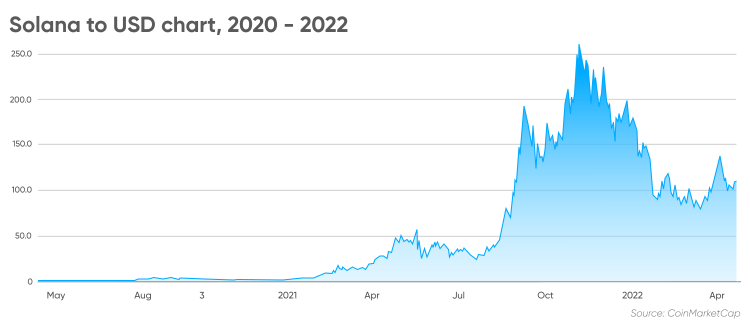
Dubbed the ‘Ethereum killer’, Solana’s native cryptocurrency, SOL, saw its price grow almost tenfold last year. However in recent months, the token has been struggling to pick up speed, losing nearly 70% of its value by mid-March 2022.

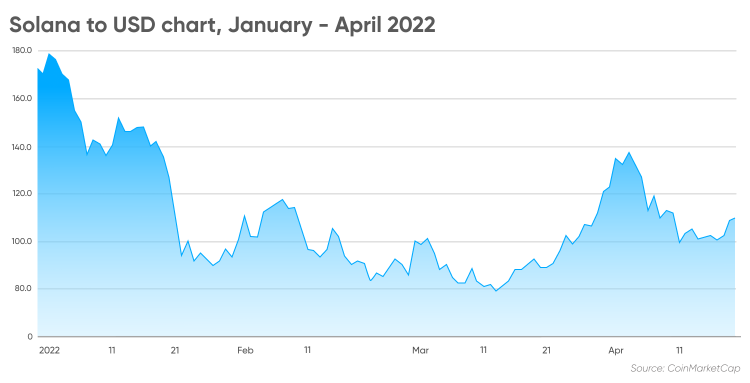
A recent spike in major outages faced by the blockchain threw many investors off, with SOL’s price falling to $107.24 by 20 April 2022.

On 12 April 2022, Solana was listed on Robinhood, with high hopes of attracting new investors. Can it regain past highs, and what’s in store for the Solana (SOL/USD) forecast?

What is Solana?

Unlike many other popular blockchains that operate using Proof-of-Work (PoW) or Proof-of-Stake (PoS) algorithms, Solana was the first to introduce a Proof-of-History (PoH) algorithm, which allows the blockchain to operate quickly while staying secure and decentralised.
Founded in 2017 by former Qualcomm employee and Dropbox software engineer Anatoly Yakovenko and his colleague Greg Fitzgerald, Solana’s main goal was to create an open-source project that implemented a new, high-performance permissionless blockchain.

Because of its PoH algorithm, Solana can process over 250,000 transactions a second , marking it as a competitor to Ethereum (ETH), the second highest cryptocurrency by market capitalisation, as of 20 April. Ethereum has become the leader in decentralised finance (DeFi) due to its compatibility with smart contracts, which enable the building of decentralised applications (dApps).

However, while Ethereum remains the second largest cryptocurrency, its popularity has also made the blockchain very expensive and slow to use, which allowed for the creation of Solana.

According to Solana’s official website, the platform is “the fastest blockchain in the world and the fastest growing ecosystem in crypto, with thousands of projects spanning DeFi, NFTs, Web3 and more”.

In addition to being fast, Solana is also cheap – average fees are less than $0.1 – and censorship-resistant, allowing the application to remain open and run freely.

Solana allows users to:

  • Mint, sell and trade non-fungible tokens (NFTs) at high throughput and low prices. As of 20 April, over 5.7m NFTs have been created on the network.
  • Create their own DeFi projects and easily write smart contracts aided by the blockchain’s high transaction throughput, very low fees, low latency and great efficiency.
  • Build Web3 games, which will operate at lightning speed.
  • Accept payments in cryptocurrencies.

Solana’s ecosystem covers a number of lending protocols, DeFi projects, NFT marketplaces, Web3 Apps and decentralised exchange (DEX) projects. It also includes Phantom, a Solana wallet built for DeFi and NFTs, and Audius, a decentralised music sharing platform.

Solana is powered by its native cryptocurrency, SOL, an ERC-20 token running on the Ethereum network. SOL is used to pay for transaction fees and any purchases in the Solana ecosystem and staking.

The total supply of SOL tokens exceeds 511m, with over 333m tokens currently in circulation, according to data provided by CoinMarketCap at the time of writing (20 April).

The SOL cryptocurrency has a market capitalisation of more than $35bn and is the 7th most popular token, above Dogecoin (DOGE), Terra (LUNA) and Shiba Inu (SHIB).

Will SOL coin price go up or down? Technical outlook

Since SOL’s launch in 2020, the coin has struggled to pick up any momentum moving sideways for around 10 months before starting to gain speed by the end of February 2021.
Between late February 2021 and mid-July 2021, the token battled values that dropped as low as $13 and did not exceed $56.

However, when the token’s value finally started to rise at the beginning of August 2021, it did so very quickly, surging by 407.1% within a month, up from $37.67 on 8 August 2021 to $191.04 on 8 September 2021, a then record high.

Solana to USD chart, 2020 - 2022

The SOL cryptocurrency reached an all-time high on 6 November 2021, hitting $258.93 – a 35.5% surge on its September 2021 value. The bullish trend was in line with other cryptocurrencies, including Ethereum (ETH), Bitcoin (BTC) and Binance (BNB).

Since then, however, the trend has reversed, with the SOL token price decreasing by 65%, down to $78.94 by 13 March 2022, amid broad negative market sentiment as tensions started to rise on the Russia-Ukraine border and the outbreak of the war.

A mini surge occurred in the following three weeks as the coin managed to win back 73.2% of its value, rising to $136.78, following the publication of Solana’s energy use report, which stated that the blockchain’s carbon footprint has greatly decreased since December 2021.

Solana to USD chart, January - April 2022

SOL token technical analysis provided by CoinCodex showed that short-term sentiment for the coin was pretty neutral at the time of writing (20 April), with 22 indicators pointing to ‘sell’ and 8 to ‘buy’.

relative strength index (RSI) reading of 27 was in oversold territory. A reading of 30 or below would indicate that the asset is becoming undervalued and a trend reversal is likely to occur. The token is trading above its five-and 10-day moving averages, yet close to its R1 resistance level of $110.82.

Is Solana (SOL) a good investment?

Some of the biggest SOL coin news came as the platform announced a change in the leadership of its Solana Foundation Council on 18 April 2022. The council was established in 2020 with the aim of advancing the adoption of decentralised technologies as a public good. It’s been helping the Solana ecosystem develop.
On 29 March 2022, Solana launched Solana Pay, a “build your own online store” application on its blockchain. It allows users to create a storefront and accept low-fee, global payments directly into their wallets without the need for a bank or credit card.

Since launching, over 600 merchants have engaged with Solana Pay while others started incorporating the ecosystem into their payment flows, thus encouraging space for new investors to join the blockchain.

What is your sentiment on ETH/USD?

On 1 April 2022, the platform also announced that the Solana Hacker House World Tour will be making a comeback in new cities globally, including London, Tokyo and Barcelona, sparking international interest.

Additionally on 12 April 2022, Solana was listed on Robinhood, which, according to BigONE Exchange chair in Asia, Anndy Lian, is likely to boost SOL coin’s future price.

“An equally impressive partnership which has supported the bullish price… is the 12 April news from popular app Robinhood that it was listing SOL for the first time,” he said.

Lian told Capital.com that in addition to the listing, the price of the SOL coin to USD has been driven by debate sparked by Tesla (TSLA) CEO Elon Musk’s bid to buy Twitter (TWTR).

“This announcement over the Web3 future of the social networking platform, prompted FTX crypto exchange CEO Sam Bankman-Fried to suggest Twitter could move on-chain using the low-cost, high-speed Solana blockchain.”

In the past, Solana has hinted at wanting to work with Musk, replying to his tweets on the social media platform.

In addition, Lian told Capital.com that FTX’s investment in its own NFT platform on Solana , as well as OpenSea’s beta version launch on the blockchain, could boost SOL coin’s future price.

“Set in the context of pressure on altcoins, the outlook for the token price could be modestly optimistic after a bearish beginning to 2022,” he told Capital.com.

“Recent partnerships news support this thesis, and it’s also supported by the ‘Social Solana Prices Estimates’ on CoinMarketCap; with over 5000 voting (median average) for a 17.75% increase in price to $121.49 by the end of April; and over 2000 voting for a $127.42 price level by the end of May.”

On the minus side, however, It’s important to note that the blockchain is prone to network outages. During March and April 2022, Solana suffered nine network outages, seven of which were determined as “major”.

“The two key risks are firstly, if the bottom falls out of the altcoin market due to a ‘black swan’ event such as a Russian default impacting the wider markets; and a specific risk being if Solana suffers another serious network outage which leaves not just users but partners looking to other layer 1 options for a low cost, high speed blockchain alternative to Ethereum,” Lian told Capital.com.

Solana prediction 2022-2025, 2030

Despite recent bearish SOL token price action, algorithm-based forecasting service Wallet Investor gave a bullish SOL coin price prediction at the time of writing (20 April).
The site noted that SOL is “an awesome investment”, adding that it has a long-term earning potential of 576.24%.

Based on its analysis of past price performance, the website expected that the token could trade at $226.371 in 2023 and jump to $726.904 by 2027.

DigitalCoinPrice supported the positive Solana (SOL) crypto price prediction, but projected a much slower pace of growth in the following years, predicting that the token could rise to $150.10 by the end of 2022, $207.89 by the end of 2024 and $230.34 by the end of 2025.

For the end of 2028, the site projected a $387.31 SOL price target. Its long-term SOL future price prediction suggested that the cryptocurrency could have the potential to reach $523.61 by 2030.

Note that price predictions can be wrong. Forecasts shouldn’t be used as a substitute for your own research. Always conduct your own due diligence. And never invest or trade money you cannot afford to lose.


Original Source: https://capital.com/solana-sol-price-prediction-is-it-a-solid-investment


j j j

NFTs: Bringing about the next level of funding social causes

NFTs: Bringing about the next level of funding social causes

NFTs are leading a revolution in fundraising for the marginalised by reaching out to a global audience and rewarding them for their contributions

Non-fungible tokens (NFTs), digital assets backed by the technology that drives cryptocurrencies, are now spurring social change by facilitating fundraising for charitable causes ranging from female empowerment to supporting philanthropic efforts in war-torn countries such as Ukraine.

This ability to fund initiatives for a range of socially important issues through the sale of NFTs could power the next growth phase for this asset class.

Crypto-based donations have been trending since 2017, when an anonymous donor created the Pineapple fund by donating 5,104 Bitcoins to support causes including international aid and life-extension research.

NFTs are used to represent popular art, real estate, intellectual property (IP) and other applications where authenticity and proof of ownership are vital.

Good causes

Although a recent phenomenon, NFTs have successfully entered mainstream transactions, overriding aspects such as age, geographic location, and intention. As the world goes through the next phase of the digital revolution, there are strong signs of NFTs becoming a vehicle for social change — from charitable events held in the most creative manner to celebrity partnerships and other forms of cryptocurrency-based donations.

NFT donations can be purely giving crypto for good causes, where donors are attracted to charities that share similar values to their own and not monetary gains, said Anndy Lian, chairman of BigONE Exchange. All the proceeds can go directly to those in need without any intermediaries — this is the true meaning of doing good using crypto and blockchain technology, according to Lian.

Easily accessible and highly convenient, this format of contributing has encouraged artists, celebrities, socialites, and the wealthy to engage with charitable causes, where cryptocurrency replaces actual currency in a win-win situation for all.

According to Aliasgar Merchant, developer relations engineer at Ignite, the most common causes benefiting from NFT donations are fighting the COVID-19 pandemic, mental health and wellbeing, animal welfare efforts like Orangutan Outreach, fighting poverty via organisations like No Hungry Kid, climate change and sports. It has also given birth to a whole new set of philanthropic organisations that bridge donors and receivers in various parts of the world.

Linking NFTs with an underlying cause allows participants to engage and get timely updates on the impact generated by their donations. Environment-focused organisations that auction NFTs representing endangered wildlife species also provide the buyers with updates on how the funds are used.

This brings about transparency that was unseen before while improving society and nature. NFT projects such as ChangeDAO, Impact, KRebels, and ARTXV are examples of how social entrepreneurs engage with a global audience to focus on often-neglected communities or causes.

Arijit Mukherjee, founder of Yunometa, an NFT marketplace, says while the Ukraine war is a terrible tragedy, the world has seen how NFTs have come to the aid of the country.

“The country itself is selling NFTs the way war bonds were sold previously to raise money. Apart from this, individuals and social causes have also banded together to send aid to the country by selling NFTs. The one that comes to mind is Kyiv mayor Vitali Klitschko’s brother raising funds through his NFT called Vandalz for Ukraine: WhIsBe x Wladimir Klitschko, the proceeds of which will go to Red Cross Ukraine and UNICEF. This is just one example for a country that has raised over $60 million in crypto donations,” Mukherjee said.

Value potential

Yunometa will come out with a series of NFTs in conjunction with various projects to save animals including tigers and elephants, he said.

Being non-fungible or non-interchangeable by design, every minted NFT is unique and has the potential to increase in value due to the inherent exclusivity and scarcity embedded in it. This is why collectors lap up NFTs from philanthropic projects, having realised that they could be even more valuable than a donated piece of art or possessions of famous personalities in the future.

Blockchain has been heralded by thought leaders as the greatest confluence of technology since the invention of the internet. It allows a multitude of applications, such as peer-to-peer smart contracts, the creation of digital assets, and data collection.

The strong social impact of blockchain can be highlighted with the example of Digital Arts for Social Impact (DASI), said Raj Kapoor, strategic advisor to Acryptoverse, a blockchain and crypto advisory firm.

He said the initiative is an innovative collection of NFTs minted on the blockchain in collaboration with artists around the world. The proceeds of the sales of these NFTs go towards the education of underprivileged children and improving their living conditions in rural communities around the world.

NFTs represent a new and novel approach to achieving equity in society while also rewarding donors with potentially invaluable digital assets. More creators and entrepreneurs are bound to collaborate and expand the horizon of NFT-based fundraising, benefitting more of humanity and fostering a better world for future generations.


Original Source: https://www.msn.com/en-in/money/topstories/nfts-bringing-about-the-next-level-of-funding-social-causes/ar-AAWm8nX

j j j