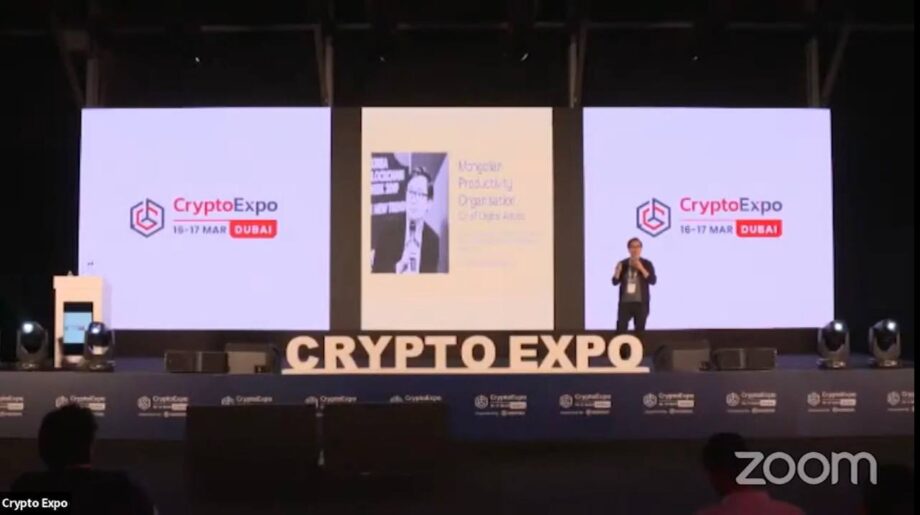
Crypto Expo Dubai is the event for Investors and Crypto Industry leaders to network and Explore more business opportunities in the Crypto Space. Meet the right Crypto Companies to Invest and Trade.
Kishu Inu Foundation decided to present and official launch its “K Project” at this event in Dubai.
Anndy Lian, is the Council Member of the Kishu Inu Foundation. He is also an early investor to the token. He joined as a Council Member in February 2022 as he wants to continue doing good with the foundation by donating and helping the less fortunate. The foundation has helped people from Brazil to Philippines, and it is still expanding its footprint.
Anndy is the Chairman of BigONE Exchange. An exchange that has been around since 2017 and is currently ranked top 40 globally. He is also the Chief Digital Advisor at Mongolia Productivity Organisation. Lian is also an investor, book author and philanthropist.
Kishu Inu ($KISHU) is a community-focused, decentralized cryptocurrency with instant rewards thanks to active users! The launch of Project K aka Kishu Kingdom is moving Kishu into the play to earn gaming space. The game is developed by Mainleaf. Mainleaf is specialized in games development since 2010. They have a diverse team with almost 50 members, covering all game development areas such as programming, art, and management. The game becomes the gateway and connector to the current Kishu Inu ecosystem.
Anndy Lian is an early blockchain adopter and experienced serial entrepreneur who is known for his work in the government sector. He is a best selling book author- “NFT: From Zero to Hero” and “Blockchain Revolution 2030”.
Currently, he is appointed as the Chief Digital Advisor at Mongolia Productivity Organization, championing national digitization. Prior to his current appointments, he was the Chairman of BigONE Exchange, a global top 30 ranked crypto spot exchange and was also the Advisory Board Member for Hyundai DAC, the blockchain arm of South Korea’s largest car manufacturer Hyundai Motor Group. Lian played a pivotal role as the Blockchain Advisor for Asian Productivity Organisation (APO), an intergovernmental organization committed to improving productivity in the Asia-Pacific region.
An avid supporter of incubating start-ups, Anndy has also been a private investor for the past eight years. With a growth investment mindset, Anndy strategically demonstrates this in the companies he chooses to be involved with. He believes that what he is doing through blockchain technology currently will revolutionise and redefine traditional businesses. He also believes that the blockchain industry has to be “redecentralised”.
As you are new to cryptocurrency trading you will have already come across and invested in the likes of Bitcoin and Ether, and started to research on alternatives such as Litecoin, which is regarded as an improved version of Bitcoin.
You’ve no doubt also decided on a sound crypto investment plan, with sufficient financial reserves to deal with losses, and set up an account with a reputable secure exchange such as BigONE to manage your trading activities.
And now having reviewed all the various options you are keen to find out what the next big thing in crypto is, which is exactly what I’m here to talk about. So, without further introduction, let’s take a deep dive into the world of meme coins, the metaverse, DeFi and an emerging exciting sector in gaming called play-as-you-earn, also known as GameFi.
But to start by setting the context, so you are the most equipped traders coming into this booming sector of crypto investment, let’s look at the rise of meme coins, created originally as a joke about crypto which have taken a life of their own as their popularity has soared and new meme coins have emerged with real world use cases since the launch of DogeCoin in 2013.
Trading tokens in the metaverse?
It’s also not hard to see meme coins use in related sectors such as music and particularly gaming, as a cross-proprietary platform currency to enable the vision of the ‘multiverse’ or more commonly known as the metaverse.
In a recent report UK-based blockchain VC Outlier Ventures sees the need to have a crypto decentralized core, with its own payment system as key to building the metaverse.
But to take a step back and explain the metaverse a little, and why it’s worth understanding from a crypto traders’ perspective. First, a definition of metaverse. In layman’s terms, a metaverse is a virtual world that exists alongside the real world. The popularity of the metaverse concept is taking serious shape in recent years, with tech titans such as Facebook, Google, Microsoft, Samsung, and Sony joining forces to form the XR Association, which is aimed at bringing this concept of an ‘experiential reality to life.
So back to the role of crypto, or the lack of it to date, in the metaverse.
Despite the frictionless use of crypto, with low fees and decentralized P2P structures, the reality is that the commercial first movers in the metaverse space from gaming have their own proprietary currencies.
What makes DeFi so attractive to the metaverse community is that it can be automated, without any centralized intervention. It also means that DeFi has long term attractions, allowing game developers and players to invest time and money knowing the underlying blockchain platform won’t change without crypto community consensus.
Cryptocurrencies have already been successfully integrated recently into virtual worlds created by companies such as Decentraland and Sandbox. For example, users in Decentraland can purchase virtual real estate such as theme parks and monetize them using cryptocurrencies. While drinks giant Coca Cola plans to launch its own NFTs on the platform, including a ‘wearable’ jacket for avatars in the Decentraland metaverse.
NFTs
As newcomers to the world of crypto trading you may not have heard of the metaverse before, but you probably heard of NFTs and the headline grabbing rise in value of these unique digital assets.
Non-fungible tokens are referred to as NFTs. According to my understanding of economics, the term fungible relates to anything that can be exchanged for something of equal value.
Most investors know that the nonfungible token (NFT) sector has been on fire since July, and as the likes of CryptoPunks (which got even more coverage when bought recently by VISA), Mutant Ape Yacht Club and pet EtherRock NFTs fetched six- and seven-figure sums, while top NFT marketplace OpenSea surpassed $4 billion in total sales.
While the frenzy has been impressive, it’s also true that many new projects have launched across a variety of blockchain networks, and the recent decline in transaction volumes could be a signal that investors are looking to move to different pastures.
The DAO, or Decentralized Autonomous Organization, is the final piece of the jigsaw that is key to the creation of a metaverse that is open, rather than one run and controlled by the Facebooks of this world. What’s interesting about this novel form of organisation, without a central leadership or the usual management structure used for companies or other entities, is that it’s giving birth to a new way to make money called play to earn or GameFi.
In a close fit with the vision of an open metaverse, play to earn crypto games are built on the fundamental need for a place that is available to everyone and owned by no one in particular.
An amalgam of gaming and decentralized finance (DeFi), ‘GameFi’ refers to the intersection between blockchain-based gaming and decentralized financial instruments in all their guises: yield farming, lending/borrowing, algorithmic stablecoins, token minting instruments, etc.
GameFi essentially means that people are playing a game to profit with real money with payment in the form of cryptocurrencies. Some players play games and earn crypto simply because they enjoy it, and the monetary rewards simply come as a bonus. While there are other players who play to earn crypto games as their main source of income.
In some play to earn crypto games, players can start playing a game for free without paying for it. While in other cases players will need to pay to play i.e., they will need to pay for the character they want to use in game, or perhaps they may want to pay for specific items they want to use in game.
The key idea is that players play games to earn crypto, and their earning potential will increase or decrease depending on the amount of time a player is willing to spend playing the games. Likewise, as a player’s skill improves so will her/his potential profits increase. With play to earn crypto games the more you play and the better you get at the game the great financial rewards you can earn.
Concluding remarks
The Motley Fool cautious analysis of MOBOX could be seen to apply to the wider set of GameFi tokens that have rocketed in value in the last few months. While there are signs the NFT market may be cooling off, and investor attention turning to DeFi in general and GameFi in particular, it’s also right to be cautious. “With Yield Guild Games (YGG) token sale netting $12.5 million in 30 seconds, [it] shows that market participants will not hesitate to switch from one hot toy to another, no different to yield farming craze earlier in the year,” Denis Vinokourov, head of research at Synergia Capital, told CoinDesk, adding that the market is still too “nascent” to make any conclusions.
A more optimistic take is that the GameFi ecosystem has started to grow and mature thanks to a plethora of unique play-to-earn models that have seen revenue generation incorporated into gameplays. Also impressive is the amount of finance being devoted to developing the infrastructure required to take GameFi to the next level. Taking an ambitious view, with consequences for trading opportunities for the future, and not just in the short term, this arguably means global adoption that rivals traditional gaming economies.
Certainly, as the metaverse becomes more and more a reality GameFi will play an important part, helping users to access a market to trade gaming assets across their favourite platforms, in turn helping grow future inter-connected play-to-earn ecosystems. Understanding this GameFi growth trend early on will enable you to better spot trading opportunities today, as well as see opportunities for the future.
Anndy Lian is an early blockchain adopter and experienced serial entrepreneur who is known for his work in the government sector. He is a best selling book author- “NFT: From Zero to Hero” and “Blockchain Revolution 2030”.
Currently, he is appointed as the Chief Digital Advisor at Mongolia Productivity Organization, championing national digitization. Prior to his current appointments, he was the Chairman of BigONE Exchange, a global top 30 ranked crypto spot exchange and was also the Advisory Board Member for Hyundai DAC, the blockchain arm of South Korea’s largest car manufacturer Hyundai Motor Group. Lian played a pivotal role as the Blockchain Advisor for Asian Productivity Organisation (APO), an intergovernmental organization committed to improving productivity in the Asia-Pacific region.
An avid supporter of incubating start-ups, Anndy has also been a private investor for the past eight years. With a growth investment mindset, Anndy strategically demonstrates this in the companies he chooses to be involved with. He believes that what he is doing through blockchain technology currently will revolutionise and redefine traditional businesses. He also believes that the blockchain industry has to be “redecentralised”.
Anndy Lian, Chairman of BigONE Exchange gave a speech at the American Digital Week event on 19 October 2021, 13:00 – GMT. His topic is about ‘Decentralized Finance – What are the Opportunities?’
The following is the summary of his speech.
This is a fantastic time to be in DeFi, driven by short and long term drivers from the explosive growth of the NFT market overtaking DeFi, the new breed of play-to-earn games or GameFi, to rise of the ‘metaverse’ as the next big thing, there’s also a lot to unpick which is exciting an a little daunting if you are new to it.
But let’s start with some basics for those of you new to DeFi. A decentralized finance (DeFi) system allows people to create financial products or “smart contracts” that execute actions automatically on the blockchain – without any bank, brokerage, exchange, or corporation acting as an intermediary.
At the end of July 2021, the market capital for DeFi products was hovering near $80 billion. While that was down from its May peak of more than $89 billion, pundits believe growth will continue in the coming year as DeFi projects mature. Key to that maturity process is innovation DeFi – creating opportunities to profitably shape a decentralized future you’ll be sure to want to be a part of.
Let’s start with non-fungible tokens or more commonly known as NFTs. The NFT industry has exploded in popularity this year. There was more than $2.5 billion in sales volume during the first half of 2021 and it has only accelerated since then. OpenSea, the most popular NFT marketplace, saw more than $3 billion in NFT sales volume just during the month of August.
So what’s driving this demand in NFTs? The fact is that digital natives would rather own digital goods than physical goods, which means that we are watching the digitization of the collectibles industry. These digital natives want to use the NFTs as a way to play games, transact with each other, and generally recreate the collectibles industry. Another perspective, as outlined recently by popular crypto podcaster Pomp, is that we are watching the birth of a new type of status:
“Each individual that would normally drop $50,000 to $1,000,000 to purchase a car, watch, house, boat, etc is now realizing that you can spend the same money on a digital good and flex in front of more people on the internet. Only so many friends can check out your house and be impressed. But millions of people a month will see your Twitter avatar. These NFTs are a great example of where I would expect billions, if not trillions, of dollars to be made in the coming years.”
As Pomp says, just as every business had to figure out an internet strategy in the 1990s, every business is going to have to figure out their bitcoin strategy and every business is going to have to figure out their NFT strategy as well.
Speaking at the recent Paris ETH event EthCC Ben Lakoff, co-founder of NFT-protocol Charged Particles highlighted NFTs as in-game items and in the metaverse as examples: “There’s actually a new publicly traded exchange-traded fund, META. In your brokerage account, you can now get exposure to the metaverse plays that are publicly traded.”
Talking of the metaverse just a few weeks ago Facebook CEO Mark Zuckerberg said within five years Facebook would be a “metaverse company” while Satya Nadella, Microsoft’s CEO, said they were investing in the “enterprise metaverse.” Simply put, whoever can integrate NFTs and payment with the metaverse may well lead the biggest change in online culture and economy since the birth of the web in the 1990s. A view supported by David Raszucki, head of the $50 billion Roblox Corporation, who sees the emergence of the metaverse as profound a shift as the invention of the internet and the world wide web.
In a close fit with the vision of an open metaverse, play to earn crypto games are built on the fundamental need for a place that is available to everyone and owned by no one in particular. An amalgam of gaming and decentralized finance (DeFi), ‘GameFi’ refers to the intersection between blockchain-based gaming and decentralized financial instruments in all their guises: yield farming, lending/borrowing, algorithmic stablecoins, token minting instruments, etc.
“Crypto has been looking for a mass market use case,” Andrew Tu, an executive at quantitative trading firm Efficient Frontier, told CoinDesk. “Gaming is a sector that people have been hyping up for a long time. It’s the first area of crypto where the average Joe without a huge understanding of crypto or blockchain can participate.”
This rise in popularity of GameFi and associated tokens has captured the attention of the wider crypto market, especially in the longer-term trend of NFTs and the metaverse. The fund’s goal is to support developers and create GameFi projects by building decentralized finance (DeFi) content, the foundation said in a press release.
“GameFi is going to be the next big thing that makes the DeFi, NFT and the larger crypto space easy to understand and be involved in,” said Sun.
A striking example of how the rise of GameFi is driving the value of tokens came in early August with Axie Infinity, the popular crypto gaming platform on Ethereum, which raked in more than $220 million in revenue in 30 days to early August, making it the top revenue generator among all DeFi protocols and blockchains, Ethereum included, according to data from Token Terminal.
Not surprisingly this phenomenal price growth has caught traders and crypto market watchers’ attention. News BTC said, “Axie Infinity has been on an absolute tear lately. The play-to-earn platform has become the face of a new integration of crypto and gaming that holds unbelievable potential. Axie Infinity has surpassed 1M daily active users and is generating more revenue than any protocol or platform with the lone exception of Ethereum. Yes, Axie Infinity is yielding more fee revenue than major platforms such as OpenSea, Uniswap, Bitcoin, or the Binance Smart Chain.”
One of the key problems associated with such rapid growth in the DeFi ecosystem is the increasing transaction costs, particularly the rapidly increasing Ethereum gas fees. To address this issue, many projects in the crypto space are starting to offer cross-chain functionality. One of the most successful innovators in this space has been Polkadot. The price of the Polkadot governance coin (DOT) has risen to over $30 from under $10 in August. This puts DOT’s market cap at over $30 billion, about the same size as Ethereum a year ago. Also worth noting is the rise of Solana, recently listed on BigOne exchange, another ‘Ethereum-killer’ with lightning fast transactions at a fraction of the price. The rapid increase in value is largely a result of crypto gaming and successful NFT launches. Amid a huge NFTs sales, resulted in a bull rally of the Solana and the price of its token SOL which, trading at $1.60 during the start of January, smashed its all-time high (ATH) $194.82 on September 7th, 2021.
Anndy Lian is an early blockchain adopter and experienced serial entrepreneur who is known for his work in the government sector. He is a best selling book author- “NFT: From Zero to Hero” and “Blockchain Revolution 2030”.
Currently, he is appointed as the Chief Digital Advisor at Mongolia Productivity Organization, championing national digitization. Prior to his current appointments, he was the Chairman of BigONE Exchange, a global top 30 ranked crypto spot exchange and was also the Advisory Board Member for Hyundai DAC, the blockchain arm of South Korea’s largest car manufacturer Hyundai Motor Group. Lian played a pivotal role as the Blockchain Advisor for Asian Productivity Organisation (APO), an intergovernmental organization committed to improving productivity in the Asia-Pacific region.
An avid supporter of incubating start-ups, Anndy has also been a private investor for the past eight years. With a growth investment mindset, Anndy strategically demonstrates this in the companies he chooses to be involved with. He believes that what he is doing through blockchain technology currently will revolutionise and redefine traditional businesses. He also believes that the blockchain industry has to be “redecentralised”.