
CZ Left Binance… Should You Also Leave for Coinbase, OKX, Etc?

CZ Left Binance… Should You Also Leave for Coinbase, OKX, Etc?

By now, you’ll be well aware that Changpeng Zhao (CZ) has resigned from the beast of an exchange that is Binance. Singaporean ex-MAS director Richard Teng has taken the reins as CEO, following in the few legal footprints left by CZ.

Over $1 billion has left the world’s largest crypto along with CZ as users withdrew their funds in response to the crypto titan pleading guilty to anti-money laundering violations in the US.

Binance was fined $4.3 billion whilst CZ himself agreed to pay a $50 million penalty.

These withdrawals are not necessarily a reflection of the confidence the market has in Teng but rather, the lack of confidence in Binance’s overall position.

As Blockhead contributor Anndy Lian explains, CZ’s supporters were disappointed in his resignation and “if not handled properly they may lose trust or interest in the exchange.”

“Moreover, CZ’s departure could also create a power vacuum or a leadership crisis within, as Teng may face resistance or opposition from some of the existing executives or employees who are loyal to CZ or who have different views or agendas,” Lian states.

Of course, the Binance fallout is serving as good news for its competitors. Crypto trading giant OKX saw its largest daily inflow of $152 million. Bybit enjoyed a $50.9 billion inflow and Bitstamp attracted $30.5 million.

“We anticipate that this will accelerate the outflow of projects, exchanges, founders and firms from direct U.S. regulatory purview,” crypto market maker Auros COO Jason Atkins told The Block. “Compliance will now be a non-negotiable so as to minimize lapses in the AML and KYC requirements in the U.S., irrespective of the country of incorporation.”

Coinbase has experienced a continuous rise in its stock price too, rising 12% over the past few days and more than 41% throughout the past month.

Reacting to Binance’s news, CEO Brian Armstrong took to Twitter to emphasise the importance of compliance.

“Since the founding of Coinbase back in 2012 we have taken a long-term view. I knew we needed to embrace compliance to become a generational company that stood the test of time,” he said. “This meant we couldn’t always move as quickly as others… Today’s news reinforces that doing it the hard way was the right decision.”

Other winners include degens who jumped onto meme coins aptly titled $CZ and $TENG, enjoying returns of up to 100,000% and 14,000% respectively.

4 Fingers, Big 4 Audit, FUD 4 Real

The image of CZ holding up four fingers has become a meme of its own. Stemming from an initial tweet he wrote earlier this year, the figure reflects CZ’s fourth item on his “Do’s and Dont’s” list: Ignore FUD.

With CZ finally exiting Binance, it’s now time to re-evaluate the FUD surrounding the exchange and whether we can apply his advice to his own firm.

As mentioned, Binance is set to pay a fine of $4.3 billion. A simple glance at Binance’s proof-of-reserves will indicate that the exchange backs customer assets one-to-one.

“People can withdraw 100% of the assets they have on Binance. We will not have an issue at any given day,” CZ reassuringly said in an interview. “In crypto, there’s no central bank printing money to bail out banks when there’s a liquidity crunch. Crypto businesses have to hold user assets one-to-one, and that’s what we do – it’s very simple.”

According to Binance, the exchange has $6.35 billion in total assets, which means it should be able to easily pay off the $4.3 billion fine without eating into customer funds.

However, Binance has refrained from disclosing its liabilities. When FTX collapsed, eyes predictably turned to Binance. At that time, CNBC’s Becky Quick pressed CZ on whether Binance could handle a $2.1 billion payment.

“Would you be able to handle it if somebody asked you for $2.1 billion back?” Quick asked him.

“We are financially OK,” CZ replied, failing to provide a direct answer.

When Quick pressed him on getting a Big 4 auditor to vet his firm, CZ claimed none wanted to work with him.

“A Big 4 auditor would reveal [problems],” Quick said. “If you’re saying that some of them don’t want to work with you, that raises questions too. They don’t want to work with you because you don’t have the files and the data that would make them feel comfortable to give their stamp of approval?”

In response, CZ pushed the blame onto the auditors. “Many of them don’t know how to audit crypto exchanges,” he said.

CNBC’s Andrew Ross Sorkin pointed out that Coinbase has a Big 4 auditor, to which a flummoxed CZ replied, “I don’t look at Coinbase.”

Star Trek or Fiction?

In CZ’s internal letter addressed to Binance staff, the now-former-CEO turned to Star Trek for words of wisdom. “I need everyone to continue performing admirably,” he said, lifting from the 2009 Star Trek film.

Binance users will now have to decide how much of what CZ told them is fiction, like his Star Trek quote. Last year, CZ was reluctant to answer whether Binance could cover a $2.1 billion fine. Its current $4.3 billion penalty is more than double that.

Whilst its proof-of-reserves points to a $6.35 billion asset stronghold, Binance’s reluctance to permit an audit means its liabilities could diminish this number substantially.

Perhaps Teng will straighten up Binance’s financials, in line with regulatory demands. But the truth could be painful to hear.


Source: https://www.blockhead.co/2023/11/23/cz-left-binance-should-you-also-leave-for-coinbase-okx-etc/

Anndy Lian is an early blockchain adopter and experienced serial entrepreneur who is known for his work in the government sector. He is a best selling book author- “NFT: From Zero to Hero” and “Blockchain Revolution 2030”.

Currently, he is appointed as the Chief Digital Advisor at Mongolia Productivity Organization, championing national digitization. Prior to his current appointments, he was the Chairman of BigONE Exchange, a global top 30 ranked crypto spot exchange and was also the Advisory Board Member for Hyundai DAC, the blockchain arm of South Korea’s largest car manufacturer Hyundai Motor Group. Lian played a pivotal role as the Blockchain Advisor for Asian Productivity Organisation (APO), an intergovernmental organization committed to improving productivity in the Asia-Pacific region.

An avid supporter of incubating start-ups, Anndy has also been a private investor for the past eight years. With a growth investment mindset, Anndy strategically demonstrates this in the companies he chooses to be involved with. He believes that what he is doing through blockchain technology currently will revolutionise and redefine traditional businesses. He also believes that the blockchain industry has to be “redecentralised”.
j j j

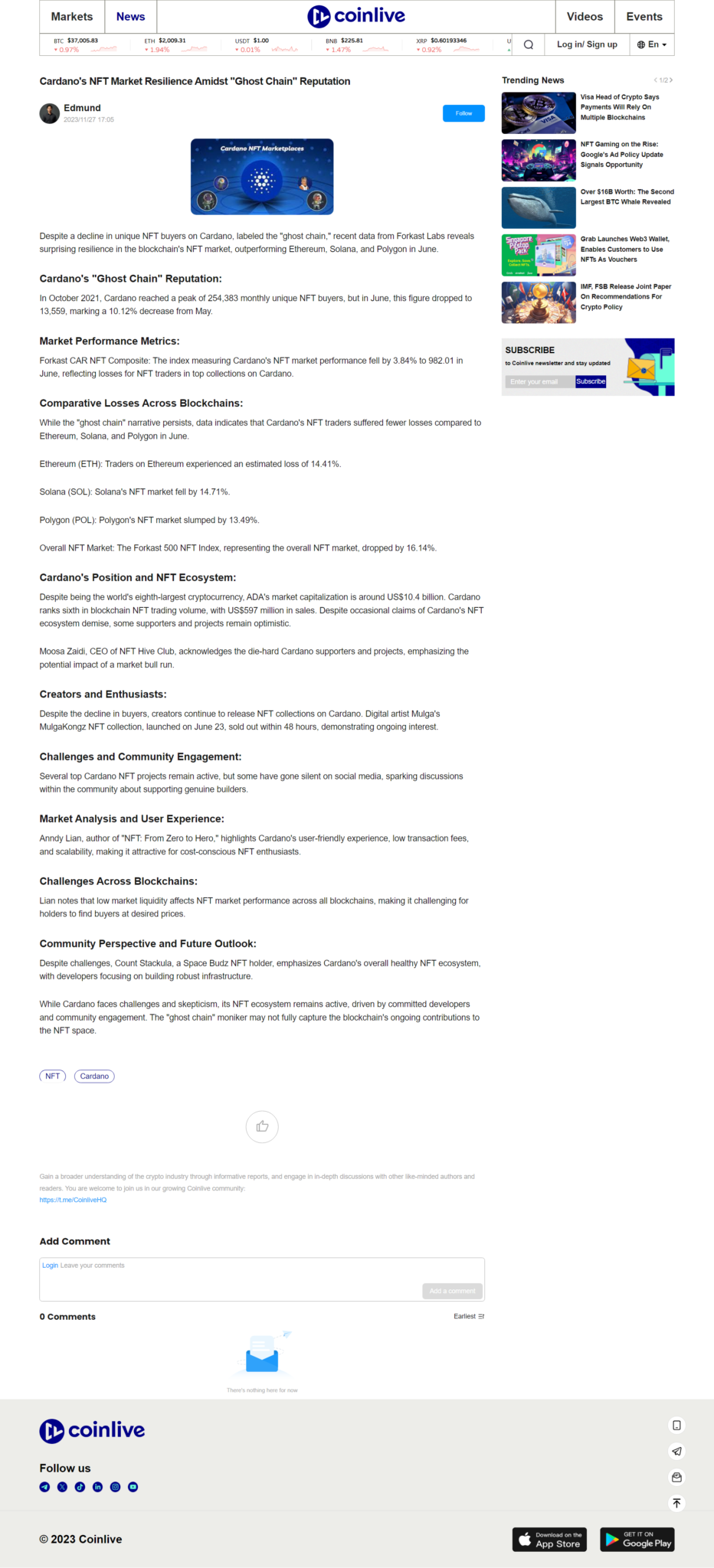
Cardano’s NFT Market Resilience Amidst “Ghost Chain” Reputation

Cardano’s NFT Market Resilience Amidst “Ghost Chain” Reputation

Despite a decline in unique NFT buyers on Cardano, labeled the “ghost chain,” recent data from Forkast Labs reveals surprising resilience in the blockchain’s NFT market, outperforming Ethereum, Solana, and Polygon in June.


Cardano’s “Ghost Chain” Reputation:

In October 2021, Cardano reached a peak of 254,383 monthly unique NFT buyers, but in June, this figure dropped to 13,559, marking a 10.12% decrease from May.


Market Performance Metrics:

Forkast CAR NFT Composite: The index measuring Cardano’s NFT market performance fell by 3.84% to 982.01 in June, reflecting losses for NFT traders in top collections on Cardano.


Comparative Losses Across Blockchains:

While the “ghost chain” narrative persists, data indicates that Cardano’s NFT traders suffered fewer losses compared to Ethereum, Solana, and Polygon in June.


Ethereum (ETH): Traders on Ethereum experienced an estimated loss of 14.41%.

Solana (SOL): Solana’s NFT market fell by 14.71%.

Polygon (POL): Polygon’s NFT market slumped by 13.49%.

Overall NFT Market: The Forkast 500 NFT Index, representing the overall NFT market, dropped by 16.14%.


Cardano’s Position and NFT Ecosystem:

Despite being the world’s eighth-largest cryptocurrency, ADA’s market capitalization is around US$10.4 billion. Cardano ranks sixth in blockchain NFT trading volume, with US$597 million in sales. Despite occasional claims of Cardano’s NFT ecosystem demise, some supporters and projects remain optimistic.


Moosa Zaidi, CEO of NFT Hive Club, acknowledges the die-hard Cardano supporters and projects, emphasizing the potential impact of a market bull run.


Creators and Enthusiasts:

Despite the decline in buyers, creators continue to release NFT collections on Cardano. Digital artist Mulga’s MulgaKongz NFT collection, launched on June 23, sold out within 48 hours, demonstrating ongoing interest.


Challenges and Community Engagement:

Several top Cardano NFT projects remain active, but some have gone silent on social media, sparking discussions within the community about supporting genuine builders.


Market Analysis and User Experience:

Anndy Lian, author of “NFT: From Zero to Hero,” highlights Cardano’s user-friendly experience, low transaction fees, and scalability, making it attractive for cost-conscious NFT enthusiasts.


Challenges Across Blockchains:

Lian notes that low market liquidity affects NFT market performance across all blockchains, making it challenging for holders to find buyers at desired prices.


Community Perspective and Future Outlook:

Despite challenges, Count Stackula, a Space Budz NFT holder, emphasizes Cardano’s overall healthy NFT ecosystem, with developers focusing on building robust infrastructure.


While Cardano faces challenges and skepticism, its NFT ecosystem remains active, driven by committed developers and community engagement. The “ghost chain” moniker may not fully capture the blockchain’s ongoing contributions to the NFT space.


Source: https://www.coinlive.com/news/cardano-s-nft-market-resilience-amidst-ghost-chain-reputation

Anndy Lian is an early blockchain adopter and experienced serial entrepreneur who is known for his work in the government sector. He is a best selling book author- “NFT: From Zero to Hero” and “Blockchain Revolution 2030”.

Currently, he is appointed as the Chief Digital Advisor at Mongolia Productivity Organization, championing national digitization. Prior to his current appointments, he was the Chairman of BigONE Exchange, a global top 30 ranked crypto spot exchange and was also the Advisory Board Member for Hyundai DAC, the blockchain arm of South Korea’s largest car manufacturer Hyundai Motor Group. Lian played a pivotal role as the Blockchain Advisor for Asian Productivity Organisation (APO), an intergovernmental organization committed to improving productivity in the Asia-Pacific region.

An avid supporter of incubating start-ups, Anndy has also been a private investor for the past eight years. With a growth investment mindset, Anndy strategically demonstrates this in the companies he chooses to be involved with. He believes that what he is doing through blockchain technology currently will revolutionise and redefine traditional businesses. He also believes that the blockchain industry has to be “redecentralised”.

j j j

Hong Kong’s Plans to Greenlight Spot Crypto ETFs

Hong Kong’s Plans to Greenlight Spot Crypto ETFs

Well, it seems that Hong Kong is seriously considering allowing spot crypto ETFs as it aims to establish itself as the hub for ‍crypto⁣ activities in Asia. This potential move by Hong​ Kong has caught the attention of financial news‍ outlet BNN Bloomberg, and they have delved into the subject. Let’s explore the ⁤discussions surrounding the authorization of‍ spot crypto ETFs and⁤ how it could position Hong Kong​ in the ever-evolving world of digital assets.

Hong Kong Poses Competitive ‌Threat To⁣ Asian Crypto Hubs

As the cryptocurrency market continues to expand and⁤ mature, the race ‍is on to establish dominant ‌hubs across Asia. Recently, Hong Kong ​has entered the race,⁢ exploring ways to authorize the trading ⁢of crypto-based Exchange Traded Funds (ETFs). These⁣ investment funds, traded on stock exchanges much ‍like traditional stocks, would offer a direct investment into the rapidly evolving world of cryptocurrencies. Richard ‍Douglas from ‍Saxo Markets has highlighted the potential benefits for local retail investors, who are keen to engage with this new asset class, but are often held back by the complexities and volatility inherent to the crypto market.

In the heart ‌of this ​potential shift is the idea of ‘Spot Crypto ETFs’.‍ A Spot ETF,‌ unlike regular ETFs, ‍would allow investors to directly hold actual cryptocurrencies rather⁤ than investing in a portfolio ‍of ⁤assets which track ⁤the underlying crypto. As of now, Hong Kong officials are assessing the feasibility and impacts of permitting‍ such investment vehicles. This initiative has‍ already seen some early‍ support ‍from financial services giant HSBC. In fact,‍ HSBC has begun offering trading of⁤ Crypto-linked ‍ETFs to ⁢their Hong⁢ Kong-based‍ customers, demonstrating an ​institutional acceptance of these novel financial ‌products.

But‌ what does this mean for‌ the broader Asian crypto landscape? By actively considering such progressive steps, Hong Kong is positioning ⁤itself as a major player in the‍ Asian cryptocurrency⁤ arena. This, in ⁤turn, could pose a competitive challenge to‌ other established or emerging crypto hubs across the region. However,⁤ the ultimate ⁣impact will depend ⁤on the delicate balance between innovation and regulation. While greater institutional acceptance and investor protections could make the crypto markets more accessible, ‍the‌ need for robust oversight and transparency remains ​paramount to ensure the⁢ continued growth and stability of these burgeoning digital assets.

The Potential of Spot Crypto ⁢Exchange-Traded Funds ​In Hong Kong

The move means an enormous‍ step forward considering⁢ that the Hong Kong Exchange (HKEX) pioneered the offering of crypto asset exposure through ETFs, further consolidating​ their footprint‍ in blockchain technology.

However, it’s essential‌ to note that while the city ⁤has shown openness to derivatives-based​ products offered‌ on exchanges specified ⁢by the Securities and Futures Commission (SFC), retail investors have faced roadblocks. To explain, a derivative-based⁢ product like a Bitcoin futures ETF, allows investors⁤ to gamble on the price of Bitcoin at ​a future date, instead of‌ buying the cryptocurrency in the present. Retail investors, mainly everyday individuals investing smaller amounts, have not yet had the opportunity to participate in these kinds of investments.

Leading technological ⁤conglomerates like Samsung ⁤Asset Management have already indicated ‍their interest in stepping into the arena, following their Bitcoin‌ futures ETF in Hong Kong. Such decisions will​ likely inspire other⁤ corporations to follow​ suit, escalating the demand and bringing spot crypto⁤ ETFs into​ regular ‌use. This success will lay a solid foundation for Hong Kong, ​paving the way to becoming a leading hub‌ for digital asset ⁤investment in Asia, and offering retail investors more opportunities to engage in the world ​of crypto assets., which cannot be understated, ⁢as their acceptance will fuel innovation, present ​diversified investment opportunities, and anchor a new era ⁣of financial ‍inclusion.

Unlocking ⁤Investment Opportunities ⁤With Hong Kong’s ETF Initiative

The news that​ Hong Kong regulators are considering allowing retail-oriented crypto Exchange Traded Funds ⁢(ETFs) comes as an‌ exciting development. As the city’s Securities ⁢and Futures Commission (SFC) proceeds with this plan, it ‍hints at the⁢ dawn of a new era in ​Hong Kong’s virtual assets sector. The move expands ‌the​ regulatory perimeter, opening ‍doors for fresh investment possibilities in the burgeoning field of crypto-assets.

At its core, an ⁤ETF is a type⁤ of security that tracks‍ an index, sector, commodity, or ​other asset, which can be purchased or sold on a stock exchange⁣ the same way a regular stock ⁣can. A crypto ETF, too, ⁢operates ⁣on the same principle but tracks one or more digital tokens. For the newcomers, this ⁢can be an ⁤attractive investment avenue as⁣ it​ provides ​them with⁢ a ‍relatively safe and regulated method to⁢ gain exposure to the often volatile crypto markets without owning the ‌underlying digital assets themselves.

This step indicates a major ⁢shift in‌ investment norms‍ and is ⁣a beacon for crypto firms and ⁢potential investors. Realizing the increasing interest and participation in ‌digital ⁤currencies,‌ Hong Kong aims to introduce new requirements for both spot-crypto and ETF investments. This initiative marks a significant stride in reinforcing its ‍position as a major fintech hub in Asia. Seizing this progression could be instrumental in promoting a wider acceptance and ‌understanding of blockchain⁣ technologies and cryptocurrencies, ⁤while ensuring investor protection in the thriving digital finance⁢ landscape.

Legislative Hurdles And Regulatory‌ Challenges In Crypto ETF ⁢Trade

Interest in these innovative financial products is soaring across the globe; they allow market ⁣participants to effectively‌ speculate​ on the potential future ​price movements of a given cryptocurrency without having ​to own it directly. But, as industry analyst ⁤Anndy Lian observed, the rise of crypto ETFs also poses significant legislative and regulatory challenges.

Among the complexities ‌to be addressed by regulators are custody issues.⁢ The SEC, the U.S. financial⁤ regulator, has been ⁣implementing new ⁣regulations surrounding the custody‌ of digital assets. Specifically, it is ‌concerned about how ownership is managed in the​ crypto universe since these assets are stored intangibly in distributed networks. To address this, the SEC​ has begun‍ to ​shift the grounds for denial of crypto ETFs from concerns about market manipulation to issues of rightful ownership and custody. This shift could potentially throw a legal wrench into Hong Kong’s plans.

Equally noteworthy are the challenges posed by cryptocurrencies themselves. Taking the cryptocurrency Ethereum as ⁢an example,‌ it ‌stands out for its ‍ability to ⁢enable smart contracts and decentralized applications. However, its intricacies also bring about certain difficulties. Since⁤ it is not solely a medium ‌of exchange like Bitcoin, but also ⁢a platform for building‍ applications, regulators ⁤might find it more challenging to categorize ​and formulate regulations around it. Nevertheless, ‍if‍ Hong Kong can successfully navigate these legislative hurdles and regulatory ‍challenges, it could cement its place as a leading crypto hub in Asia.

Efficient Ways To Capitalize On ⁢Hong Kong’s Potential Crypto Boom

However, the approval⁢ of these ETFs ⁤is yet⁢ to be confirmed, as regulators weigh⁢ the benefits and risks linked⁢ to this new asset class. Amid this backdrop of opportunity, individuals ‍keen on⁣ capitalizing on Hong‌ Kong’s potential crypto ​growth need to remain patient, stay informed, and possibly consider financial advice from‌ professionals in the crypto field. This strategic approach would offer the best chance of maximizing potential gains while minimizing possible losses. Cryptocurrency, while ⁢unpredictable, offers new avenues for technological innovation and investment growth.

In conclusion, the ‍proposed initiative by Hong⁢ Kong to allow spot crypto ETFs marks a significant step in its ambition to establish itself​ as​ the leading ⁣cryptocurrency hub in Asia. With its forward-thinking approach, the‍ city is positioning itself to ⁤attract investors and foster ⁢innovation in the ⁤rapidly evolving ‍crypto ‌market.


Source: https://techmalak.com/hong-kongs-plans-to-greenlight-spot-crypto-etfs/

Anndy Lian is an early blockchain adopter and experienced serial entrepreneur who is known for his work in the government sector. He is a best selling book author- “NFT: From Zero to Hero” and “Blockchain Revolution 2030”.

Currently, he is appointed as the Chief Digital Advisor at Mongolia Productivity Organization, championing national digitization. Prior to his current appointments, he was the Chairman of BigONE Exchange, a global top 30 ranked crypto spot exchange and was also the Advisory Board Member for Hyundai DAC, the blockchain arm of South Korea’s largest car manufacturer Hyundai Motor Group. Lian played a pivotal role as the Blockchain Advisor for Asian Productivity Organisation (APO), an intergovernmental organization committed to improving productivity in the Asia-Pacific region.

An avid supporter of incubating start-ups, Anndy has also been a private investor for the past eight years. With a growth investment mindset, Anndy strategically demonstrates this in the companies he chooses to be involved with. He believes that what he is doing through blockchain technology currently will revolutionise and redefine traditional businesses. He also believes that the blockchain industry has to be “redecentralised”.

j j j