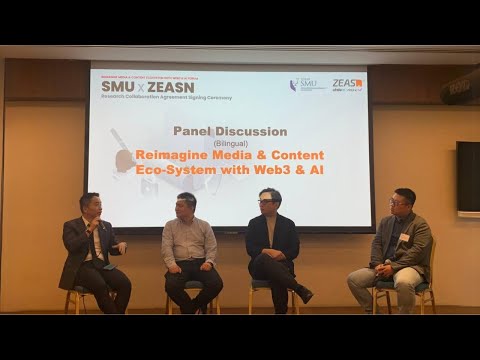
Panel Discussion- Reimagine Media & Content Ecosystem with Web3 & AI

Panel Discussion- Reimagine Media & Content Ecosystem with Web3 & AI

Media and entertainment are constantly changing. This change is crucial to how we enjoy the content, use technology, and safeguard user data. Web3 and AI (Artificial Intelligence) are new technologies that transform the landscape further. They affect how we enjoy content, use technology, and safeguard user data. A panel discussion with Feida Zhu, Associate Dean at SMU; James Liu, Director at Alibaba Cloud; Raymond Chung, CTO at ZEASN; and Anndy Lian, Advisor at Bybit, explored this topic.

AI and the New Era of Contents

Smartphones and portable devices have reduced traditional TV viewership. People want more convenient and interactive content consumption. This shift makes experts wonder about TV’s future. Many think that AI can make TV more interactive and engaging. AI can give personalized suggestions, enable real-time interaction, and improve the viewing experience. AI-powered TVs can follow voice commands, adjust to users’ tastes, and even provide educational content for kids.

Anndy commented: “AI can transform TV from a passive experience into an interactive one. Imagine a world where your TV is not just a screen but a knowledgeable companion. It can ask what kind of movie you’d like to watch, suggest content based on your preferences, and even help you with tasks like gaming or education.”

He added that AI can play a significant role in generating high-quality content. By using AI technology, content producers can create engaging, diverse, and unique content, ensuring that there is always something exciting to watch.

Raymond shared his experience: “The integration of AI technology into the content creation process is another exciting prospect. With AI’s ability to generate high-quality content, it becomes possible to produce many new, engaging materials. This means AI can generate dynamic, interactive, and even personalized content, enhancing the user’s experience.

AI’s capabilities can extend beyond entertainment to areas like education and gaming. For instance, AI can create educational content tailored to a student’s learning style or generate interactive gaming experiences that adapt to a player’s skills and preferences. With AI, content creation is limited only by our imagination.”

Web3, Blockchain and the Promise of Transparency

Web3 technology is becoming more important in the entertainment industry. Web3, based on blockchain and decentralized networks, wants to create a safe and clear space for content creators, users, and service providers.

“One major advantage of Web3 is data privacy and security. Traditional platforms often collect massive amounts of user data, raising concerns about privacy and data breaches. With Web3, data can be stored securely on decentralized networks, ensuring users have more control over their personal information.” James explained.

Feida continued by say that Web3 also enables creators to tokenize their influence. Using blockchain, content creators can create and manage their tokens, representing their influence or popularity. These tokens can be traded or used within the ecosystem, creating a more fair and sustainable economy for content creators and their audiences.

Blockchain’s transparency can also prevent piracy issues. It can check and confirm content ownership, making illegal content distribution difficult. AI can better engage users with trust and control. We need to be careful of fake and altered content. Blockchain can help as a control tool. By using blockchain to check content’s authenticity, we can ensure that what we see and hear is real.

Blockchain can also give transparency and accountability, which are important for fighting misinformation and supporting reliable content. By mixing AI’s creativity with blockchain’s security, we can make a safer and more immersive digital space.

In Summary

AI, Web3, and data privacy and security transform entertainment. They affect how we enjoy content, create and distribute it, and safeguard our data. They also offer the entertainment industry new opportunities and challenges.

We need to use these technologies well and care about data privacy and ethical AI. The entertainment industry will soon face a big change, and only those who can adjust to the new situation will succeed in the digital age.

Anndy Lian is an early blockchain adopter and experienced serial entrepreneur who is known for his work in the government sector. He is a best selling book author- “NFT: From Zero to Hero” and “Blockchain Revolution 2030”.

Currently, he is appointed as the Chief Digital Advisor at Mongolia Productivity Organization, championing national digitization. Prior to his current appointments, he was the Chairman of BigONE Exchange, a global top 30 ranked crypto spot exchange and was also the Advisory Board Member for Hyundai DAC, the blockchain arm of South Korea’s largest car manufacturer Hyundai Motor Group. Lian played a pivotal role as the Blockchain Advisor for Asian Productivity Organisation (APO), an intergovernmental organization committed to improving productivity in the Asia-Pacific region.

An avid supporter of incubating start-ups, Anndy has also been a private investor for the past eight years. With a growth investment mindset, Anndy strategically demonstrates this in the companies he chooses to be involved with. He believes that what he is doing through blockchain technology currently will revolutionise and redefine traditional businesses. He also believes that the blockchain industry has to be “redecentralised”.

j j j

Generative AI: A Game-Changer for Public Sector Automation

Generative AI: A Game-Changer for Public Sector Automation

Technology reigns supreme and data is the new gold, the public sector is poised for a transformation like never before. Artificial Intelligence (AI), particularly generative AI, is emerging as a formidable tool capable of supercharging automation in the public sector, ushering in an era of unprecedented efficiency, cost savings, and improved citizen services.

At the recent UiPath AI-Powered Automation Summit, leaders from UiPath, the Singapore Government, and Singapore General Hospital gathered to discuss the potential of generative AI in reshaping public sector agencies. I will explore the possibilities and implications of employing generative AI in the public sector, drawing insights from global experiences.

Generative AI: The Powerhouse Behind Automation

Generative AI, a subset of artificial intelligence, is the technological marvel responsible for creating content, data, or solutions autonomously. It utilizes deep learning algorithms, often in the form of neural networks, to generate human-like outputs from a given input. This technology is the driving force behind innovations like natural language generation, image synthesis, and even autonomous content creation.

Generative ai market

The UiPath AI-Powered Automation Summit highlighted how generative AI can revolutionize the way public sector agencies operate. Let’s dive into some key areas where generative AI can make a substantial impact:

  1. Streamlining Administrative Tasks: Public sector agencies often grapple with mountains of paperwork and repetitive administrative tasks. Generative AI can automate data entry, document processing, and even generate reports, freeing up human resources for more strategic endeavors.
  2. Enhancing Citizen Services: Improved chatbots powered by generative AI can provide citizens with instant, personalized assistance. Whether it’s answering queries about government services or guiding citizens through complex procedures, AI-driven chatbots can be available 24/7.
  3. Data Quality Enhancement: Generative AI can assist in the enhancement of data quality. For instance, in the case of the Philippine Identification System Act, where low-quality photos hamper the process, AI can upscale and enhance image quality, ensuring the integrity of the biometric database.
  4. Cost Reduction: The deployment of generative AI can significantly reduce operational costs. By automating routine tasks and optimizing resource allocation, public sector organizations can allocate resources more efficiently and reduce the burden on taxpayers.
  5. Efficient Cloud Services: In Thailand’s case, where the Government Data Centre and Cloud (GDCC) is grappling with high demand, generative AI can help optimize cloud resource allocation and improve scalability. It can also assist in negotiating benchmark rental fees with private cloud providers, ensuring cost-effective solutions.

Challenges and Considerations

While the potential of generative AI in the public sector is immense, it is essential to address potential challenges and ethical considerations:

  1. Data Privacy and Security: With the increased reliance on AI for citizen services, safeguarding sensitive data is paramount. Robust data encryption, access controls, and stringent privacy policies are essential.
  2. Algorithmic Bias: AI systems can inherit biases from the data they are trained on. Public sector agencies must ensure that AI systems are fair, transparent, and do not discriminate against any group.
  3. Human-AI Collaboration: The integration of AI should complement human efforts, not replace them. Public sector employees must be upskilled to work alongside AI systems effectively.
  4. Ethical Decision-Making: AI systems may need to make ethical decisions, such as in healthcare or law enforcement. Establishing ethical guidelines and accountability mechanisms is crucial.

Singapore’s Pioneering Role in Public Sector AI Adoption

Singapore, often hailed as a global tech hub, has made significant strides in harnessing the power of artificial intelligence (AI) within its public sector. The nation’s unwavering commitment to digital transformation has yielded innovative solutions that are not only reshaping the way government services are delivered but also enhancing the quality of life for its citizens.

One of the most prominent examples of Singapore’s foray into AI-powered public service is the introduction of “ChatGPT.” This advanced chatbot has emerged as a trusted companion for Singaporean citizens seeking information or assistance with various government-related queries and transactions. ChatGPT’s capabilities extend beyond mere information retrieval; it embodies the potential of AI to provide personalized, efficient, and round-the-clock services to the public.

The implementation of ChatGPT within the government’s digital infrastructure has streamlined administrative processes, reduced response times, and, perhaps most importantly, improved accessibility to vital government services. Citizens can now engage with government agencies and access critical information without the constraints of office hours or the need for direct human interaction. This accessibility promotes inclusivity, benefiting all segments of the population, regardless of their technological proficiency.

Furthermore, Singapore General Hospital’s adoption of generative AI for medical imaging represents a groundbreaking advancement in the healthcare sector. By integrating AI into the analysis of medical images, the hospital has significantly enhanced its diagnostic capabilities. This AI-driven approach allows for more rapid and accurate detection of diseases, potentially saving lives and reducing the burden on healthcare professionals.

Generative AI’s application in medical imaging enables the early identification of anomalies and abnormalities, thus facilitating timely interventions and treatments. This not only improves patient outcomes but also contributes to the overall efficiency of the healthcare system. Additionally, the reduction in the time required for diagnosis translates into reduced healthcare costs and improved patient experiences.

The Philippines’ Digitalization Dilemma and the Promise of Generative AI

In contrast to Singapore’s well-established digital landscape, the Philippines presents a unique set of challenges and opportunities in its pursuit of digital transformation. The implementation of the Philippine Identification System Act, a critical initiative aimed at providing citizens with a national ID, holds immense promise but also encounters formidable obstacles.

One of the most significant challenges faced by the Philippine government in this endeavor is the quality of biometric data stored in the national database. Low-quality photos and inaccuracies in the database could potentially hinder the ID issuance process and compromise the integrity of the system. However, this challenge is not insurmountable, and here lies the potential of generative AI to act as a game-changer.

Generative AI’s ability to enhance image quality and accuracy can play a pivotal role in rectifying these data-related issues. Through sophisticated algorithms and deep learning techniques, AI can analyze and improve the quality of images, ensuring that biometric data is both reliable and accurate. This not only streamlines the process of issuing national IDs but also enhances the security and effectiveness of the entire identification system.

However, as the Philippine government ventures further into rapid digitalization, it must confront the critical issues of data privacy and security. The handling of vast amounts of sensitive personal information necessitates robust safeguards and stringent regulations. The government must prioritize the development and implementation of comprehensive data protection measures to instill public trust in the digitalization process.

Furthermore, as generative AI is leveraged to address data quality concerns, it is essential to maintain transparency and accountability. Citizens must have confidence that their data is being handled ethically and responsibly, with clear guidelines in place to prevent misuse or unauthorized access.

Conclusion: A New Era of Public Service

Generative AI holds the promise of revolutionizing public sector operations, ushering in an era of efficiency, cost-effectiveness, and improved citizen services. From streamlining administrative tasks to enhancing data quality and optimizing cloud services, the potential applications are vast. However, it is imperative for governments to navigate the ethical and privacy considerations while ensuring that AI complements human efforts.

As we look ahead, the experiences of countries like Singapore and Philippines, provide valuable insights into the transformative power of generative AI in the public sector. Embracing this technology with a responsible and forward-thinking approach can lead to a brighter future for public service delivery, ultimately benefiting citizens around the world. The journey toward a more automated and efficient public sector has begun, and generative AI is at the forefront of this exciting transformation.

Source: https://www.tradingview.com/news/financemagnates:f718dbf81094b:0-generative-ai-a-game-changer-for-public-sector-automation/

Anndy Lian is an early blockchain adopter and experienced serial entrepreneur who is known for his work in the government sector. He is a best selling book author- “NFT: From Zero to Hero” and “Blockchain Revolution 2030”.

Currently, he is appointed as the Chief Digital Advisor at Mongolia Productivity Organization, championing national digitization. Prior to his current appointments, he was the Chairman of BigONE Exchange, a global top 30 ranked crypto spot exchange and was also the Advisory Board Member for Hyundai DAC, the blockchain arm of South Korea’s largest car manufacturer Hyundai Motor Group. Lian played a pivotal role as the Blockchain Advisor for Asian Productivity Organisation (APO), an intergovernmental organization committed to improving productivity in the Asia-Pacific region.

An avid supporter of incubating start-ups, Anndy has also been a private investor for the past eight years. With a growth investment mindset, Anndy strategically demonstrates this in the companies he chooses to be involved with. He believes that what he is doing through blockchain technology currently will revolutionise and redefine traditional businesses. He also believes that the blockchain industry has to be “redecentralised”.

j j j

Generative AI: A Game-Changer for Public Sector Automation

Generative AI: A Game-Changer for Public Sector Automation
  • ChatGPT integration within the government’s digital infrastructure has improved response time to essential services.
  • Singapore General Hospital’s adoption of generative AI for medical imaging represents a massive advancement in the sector.

Technology reigns supreme and data is the new gold, the public sector is poised for a transformation like never before. Artificial Intelligence (AI), particularly generative AI, is emerging as a formidable tool capable of supercharging automation in the public sector, ushering in an era of unprecedented efficiency, cost savings, and improved citizen services.

At the recent UiPath AI-Powered Automation Summit, leaders from UiPath, the Singapore Government, and Singapore General Hospital gathered to discuss the potential of generative AI in reshaping public sector agencies. I will explore the possibilities and implications of employing generative AI in the public sector, drawing insights from global experiences.

Generative AI: The Powerhouse Behind Automation

Generative AI, a subset of artificial intelligence, is the technological marvel responsible for creating content, data, or solutions autonomously. It utilizes deep learning algorithms, often in the form of neural networks, to generate human-like outputs from a given input. This technology is the driving force behind innovations like natural language generation, image synthesis, and even autonomous content creation.

Generative ai market

The UiPath AI-Powered Automation Summit highlighted how generative AI can revolutionize the way public sector agencies operate. Let’s dive into some key areas where generative AI can make a substantial impact:

  1. Streamlining Administrative Tasks: Public sector agencies often grapple with mountains of paperwork and repetitive administrative tasks. Generative AI can automate data entry, document processing, and even generate reports, freeing up human resources for more strategic endeavors.
  2. Enhancing Citizen Services: Improved chatbots powered by generative AI can provide citizens with instant, personalized assistance. Whether it’s answering queries about government services or guiding citizens through complex procedures, AI-driven chatbots can be available 24/7.
  3. Data Quality Enhancement: Generative AI can assist in the enhancement of data quality. For instance, in the case of the Philippine Identification System Act, where low-quality photos hamper the process, AI can upscale and enhance image quality, ensuring the integrity of the biometric database.
  4. Cost Reduction: The deployment of generative AI can significantly reduce operational costs. By automating routine tasks and optimizing resource allocation, public sector organizations can allocate resources more efficiently and reduce the burden on taxpayers.
  5. Efficient Cloud Services: In Thailand’s case, where the Government Data Centre and Cloud (GDCC) is grappling with high demand, generative AI can help optimize cloud resource allocation and improve scalability. It can also assist in negotiating benchmark rental fees with private cloud providers, ensuring cost-effective solutions.

Challenges and Considerations

While the potential of generative AI in the public sector is immense, it is essential to address potential challenges and ethical considerations:

  1. Data Privacy and Security: With the increased reliance on AI for citizen services, safeguarding sensitive data is paramount. Robust data encryption, access controls, and stringent privacy policies are essential.
  2. Algorithmic Bias: AI systems can inherit biases from the data they are trained on. Public sector agencies must ensure that AI systems are fair, transparent, and do not discriminate against any group.
  3. Human-AI Collaboration: The integration of AI should complement human efforts, not replace them. Public sector employees must be upskilled to work alongside AI systems effectively.
  4. Ethical Decision-Making: AI systems may need to make ethical decisions, such as in healthcare or law enforcement. Establishing ethical guidelines and accountability mechanisms is crucial.

Singapore’s Pioneering Role in Public Sector AI Adoption

Singapore, often hailed as a global tech hub, has made significant strides in harnessing the power of artificial intelligence (AI) within its public sector. The nation’s unwavering commitment to digital transformation has yielded innovative solutions that are not only reshaping the way government services are delivered but also enhancing the quality of life for its citizens.

One of the most prominent examples of Singapore’s foray into AI-powered public service is the introduction of “ChatGPT.” This advanced chatbot has emerged as a trusted companion for Singaporean citizens seeking information or assistance with various government-related queries and transactions. ChatGPT’s capabilities extend beyond mere information retrieval; it embodies the potential of AI to provide personalized, efficient, and round-the-clock services to the public.

The implementation of ChatGPT within the government’s digital infrastructure has streamlined administrative processes, reduced response times, and, perhaps most importantly, improved accessibility to vital government services. Citizens can now engage with government agencies and access critical information without the constraints of office hours or the need for direct human interaction. This accessibility promotes inclusivity, benefiting all segments of the population, regardless of their technological proficiency.

Furthermore, Singapore General Hospital’s adoption of generative AI for medical imaging represents a groundbreaking advancement in the healthcare sector. By integrating AI into the analysis of medical images, the hospital has significantly enhanced its diagnostic capabilities. This AI-driven approach allows for more rapid and accurate detection of diseases, potentially saving lives and reducing the burden on healthcare professionals.

Generative AI’s application in medical imaging enables the early identification of anomalies and abnormalities, thus facilitating timely interventions and treatments. This not only improves patient outcomes but also contributes to the overall efficiency of the healthcare system. Additionally, the reduction in the time required for diagnosis translates into reduced healthcare costs and improved patient experiences.

The Philippines’ Digitalization Dilemma and the Promise of Generative AI

In contrast to Singapore’s well-established digital landscape, the Philippines presents a unique set of challenges and opportunities in its pursuit of digital transformation. The implementation of the Philippine Identification System Act, a critical initiative aimed at providing citizens with a national ID, holds immense promise but also encounters formidable obstacles.

One of the most significant challenges faced by the Philippine government in this endeavor is the quality of biometric data stored in the national database. Low-quality photos and inaccuracies in the database could potentially hinder the ID issuance process and compromise the integrity of the system. However, this challenge is not insurmountable, and here lies the potential of generative AI to act as a game-changer.

Generative AI’s ability to enhance image quality and accuracy can play a pivotal role in rectifying these data-related issues. Through sophisticated algorithms and deep learning techniques, AI can analyze and improve the quality of images, ensuring that biometric data is both reliable and accurate. This not only streamlines the process of issuing national IDs but also enhances the security and effectiveness of the entire identification system.

However, as the Philippine government ventures further into rapid digitalization, it must confront the critical issues of data privacy and security. The handling of vast amounts of sensitive personal information necessitates robust safeguards and stringent regulations. The government must prioritize the development and implementation of comprehensive data protection measures to instill public trust in the digitalization process.

Furthermore, as generative AI is leveraged to address data quality concerns, it is essential to maintain transparency and accountability. Citizens must have confidence that their data is being handled ethically and responsibly, with clear guidelines in place to prevent misuse or unauthorized access.

Conclusion: A New Era of Public Service

Generative AI holds the promise of revolutionizing public sector operations, ushering in an era of efficiency, cost-effectiveness, and improved citizen services. From streamlining administrative tasks to enhancing data quality and optimizing cloud services, the potential applications are vast. However, it is imperative for governments to navigate the ethical and privacy considerations while ensuring that AI complements human efforts.

As we look ahead, the experiences of countries like Singapore and Philippines, provide valuable insights into the transformative power of generative AI in the public sector. Embracing this technology with a responsible and forward-thinking approach can lead to a brighter future for public service delivery, ultimately benefiting citizens around the world. The journey toward a more automated and efficient public sector has begun, and generative AI is at the forefront of this exciting transformation.

Source: https://www.financemagnates.com/fintech/generative-ai-a-game-changer-for-public-sector-automation/

Anndy Lian is an early blockchain adopter and experienced serial entrepreneur who is known for his work in the government sector. He is a best selling book author- “NFT: From Zero to Hero” and “Blockchain Revolution 2030”.

Currently, he is appointed as the Chief Digital Advisor at Mongolia Productivity Organization, championing national digitization. Prior to his current appointments, he was the Chairman of BigONE Exchange, a global top 30 ranked crypto spot exchange and was also the Advisory Board Member for Hyundai DAC, the blockchain arm of South Korea’s largest car manufacturer Hyundai Motor Group. Lian played a pivotal role as the Blockchain Advisor for Asian Productivity Organisation (APO), an intergovernmental organization committed to improving productivity in the Asia-Pacific region.

An avid supporter of incubating start-ups, Anndy has also been a private investor for the past eight years. With a growth investment mindset, Anndy strategically demonstrates this in the companies he chooses to be involved with. He believes that what he is doing through blockchain technology currently will revolutionise and redefine traditional businesses. He also believes that the blockchain industry has to be “redecentralised”.

j j j