
The Bright Future of Crypto: Anndy Lian’s Predictions for 2030

The Bright Future of Crypto: Anndy Lian’s Predictions for 2030

The year 2030 marks a pivotal era in finance where cryptocurrencies, once considered on the fringe and associated with speculation, have now become an integral part of the global economy.

That’s the view of Anndy Lian, who illuminated the factors that propelled this rapid surge in crypto’s acceptance in his enlightening closing speech at the Bitcoin Cash (BCH) Seoul Meetup. As we delve into the future, what obstacles and opportunities are expected to shape the trajectory of the crypto industry and its users?

The Surge in Cryptocurrency Adoption

Blockchain, the pioneering backbone of cryptocurrencies, has revolutionized how transactions are recorded and managed. Its innovative distributed ledger system stands as the linchpin behind the widespread adoption of cryptocurrencies. This groundbreaking technology securely logs transactions in an unchangeable, transparent manner, facilitating direct peer-to-peer exchanges without intermediaries. By bypassing middlemen, blockchain significantly reduces transaction costs and friction, ultimately enhancing efficiency and fostering greater trust among participants.

The evolution of blockchain technology has given rise to a rich array of crypto assets that extend far beyond just Bitcoin (BTC) and Ethereum (ETH). This spectrum includes stablecoins, utility tokens, security tokens, and non-fungible tokens, each designed with distinct functionalities. These assets serve a multitude of purposes, ranging from acting as a secure store of value to enabling seamless exchanges of digital assets, representing tangible real-world assets in a digital format, granting access to decentralized applications (DApps), and enabling ownership of unique digital collectibles.

Forecasts from a comprehensive study conducted by Grand View Research, Inc. paint a compelling picture of the future trajectory of the global cryptocurrency market. The study predicts that by 2030, the market is poised to burgeon to an impressive USD 4,600 billion. This anticipated growth reflects a robust annual expansion rate of 7.1% from 2021 to 2030.

Escalating demands from both retail and institutional investors drive such exponential growth. Additionally, the integration of blockchain technology across a diverse spectrum of industries plays a pivotal role in transforming how businesses operate and transactions are conducted.

Furthermore, the backing of supportive regulations in specific nations contributes significantly to this upward surge, fostering an environment conducive to the flourishing of cryptocurrencies and their associated technologies.

Rising Popularity and Mainstream Embrace

The rise in awareness and understanding among the general populace stands as a pivotal driver behind the soaring popularity of cryptocurrencies. More and more individuals are gaining insights into the potential advantages that cryptocurrencies offer, including their role in fostering financial inclusivity, empowerment, privacy, and autonomy. This increasing knowledge has propelled the uptake of cryptocurrencies.

The availability of diverse platforms and services has played a crucial role in expediting the adoption of cryptocurrencies. These platforms encompass exchanges facilitating crypto trading, wallets for securely storing digital assets, and lending platforms offering innovative financial services within the crypto sphere. Their widespread availability has simplified access for newcomers and seasoned users alike, fueling the growth of cryptocurrency adoption on a global scale.

Forecasts by some analysts, such as Boston Consulting Group (BCG), Bitget, and Foresight Ventures, present an astonishing forecast: surpassing one billion crypto users by 2030. This exponential surge is fueled by a historic growth rate of 63.2% annually.

A multitude of factors contribute to this anticipated surge in crypto users. Notably, the expanding reach and influence of flagship cryptocurrencies like Bitcoin and Ethereum, the emergence of groundbreaking trends like decentralized finance (DeFi) and non-fungible tokens (NFTs), institutional involvement through specialized crypto products, and endorsements by influential personalities collectively drive the mass adoption of cryptocurrencies.

These factors, coupled with the continuous evolution and innovation within the crypto space, are poised to reshape the financial landscape and solidify cryptocurrencies’ position as a mainstream and transformative force in the global economy.

Decentralization: Pillar of Web3

Decentralization serves as the fundamental and revolutionary aspect of cryptocurrencies, defining a system where control isn’t centralized but shared among participants. This concept applies to networks, protocols, or data structures where power and accountability are distributed. It encourages collaboration through consensus mechanisms and economic models that reward cooperative actions.

At the heart of Web3 lies the vision for a next-generation internet constructed upon blockchain and related distributed technologies. Decentralization within Web3 aims to create a more open, fair, and democratic web environment. In this paradigm, users gain increased control and ownership over their data, identity, and digital assets. This shift in power dynamics allows individuals to have a greater say in how their information is used and shared.

Web3’s impact extends beyond mere ownership; it facilitates the development of decentralized applications (DApps), which operate on distributed networks, ensuring greater transparency and security. Smart contracts, encoded within these networks, execute predefined actions autonomously based on predefined conditions, fostering trustless and transparent transactions.

Governance mechanisms within Web3 enable decentralized decision-making processes, allowing stakeholders to actively participate in the management and evolution of the network or platform. Furthermore, the rise of decentralized finance within Web3 has disrupted traditional financial systems, providing innovative and accessible financial services without the need for intermediaries.

Looking ahead, the evolution into Web4 is envisioned, aiming to integrate the physical and digital realms more seamlessly. This next evolution would merge technologies such as artificial intelligence (AI), virtual reality (VR), and the Internet of Things (IoT) into a cohesive ecosystem, further blurring the boundaries between the physical and digital worlds.

The underlying premise of decentralization within Web3 paves the way for a future where users have increased sovereignty over their digital lives, fostering a more transparent, inclusive, and interconnected global landscape.

Challenges and Opportunities Ahead

Despite significant advancements, the landscape of cryptocurrencies faces persistent challenges. The lack of clear regulations across different regions poses substantial risks and obstacles for users, developers, and businesses involved in the crypto space. Additionally, ensuring the robust security and scalability of crypto networks remains a top priority, especially considering the intricate technical intricacies involved.

Addressing these challenges also involves bridging educational gaps and streamlining adoption processes, which are crucial components for realizing the full potential of cryptocurrencies. Simplifying the understanding of cryptocurrencies and their usage can significantly contribute to their widespread acceptance and integration into mainstream use.

Amidst these hurdles, numerous opportunities arise. The collaborative spirit and innovative drive within the crypto community continue to foster groundbreaking advancements and enhance accessibility. This collective creativity holds the potential to empower individuals who are unbanked or marginalized, providing them with access to financial services and opportunities previously unavailable to them.

The transformative impact of cryptocurrencies extends beyond just finance, permeating various industries. Cryptocurrencies have the potential to disrupt traditional models, offering novel solutions that are peer-to-peer and decentralized. These alternatives challenge existing norms, creating avenues for more inclusive, transparent, and equitable systems across different sectors.

The Bottom Line

Cryptocurrency transcends its technical aspects; it symbolizes a movement advocating for transparency, fairness, and democracy. It embodies a cultural shift fostering innovation, collaboration, and diversity. Envisioning a future where everyone has equal access to and benefits from the digital economy is at the core of this vision.

Looking ahead to 2030, one can anticipate crypto’s continued growth, evolution, and the navigation of new challenges and prospects. Its impact will endure, shaping not only the future of currency but also becoming a cornerstone in shaping finance, the web, and the global landscape as a whole.


Source: https://www.techopedia.com/anndy-lian-looking-ahead-to-cryptos-future-in-2030
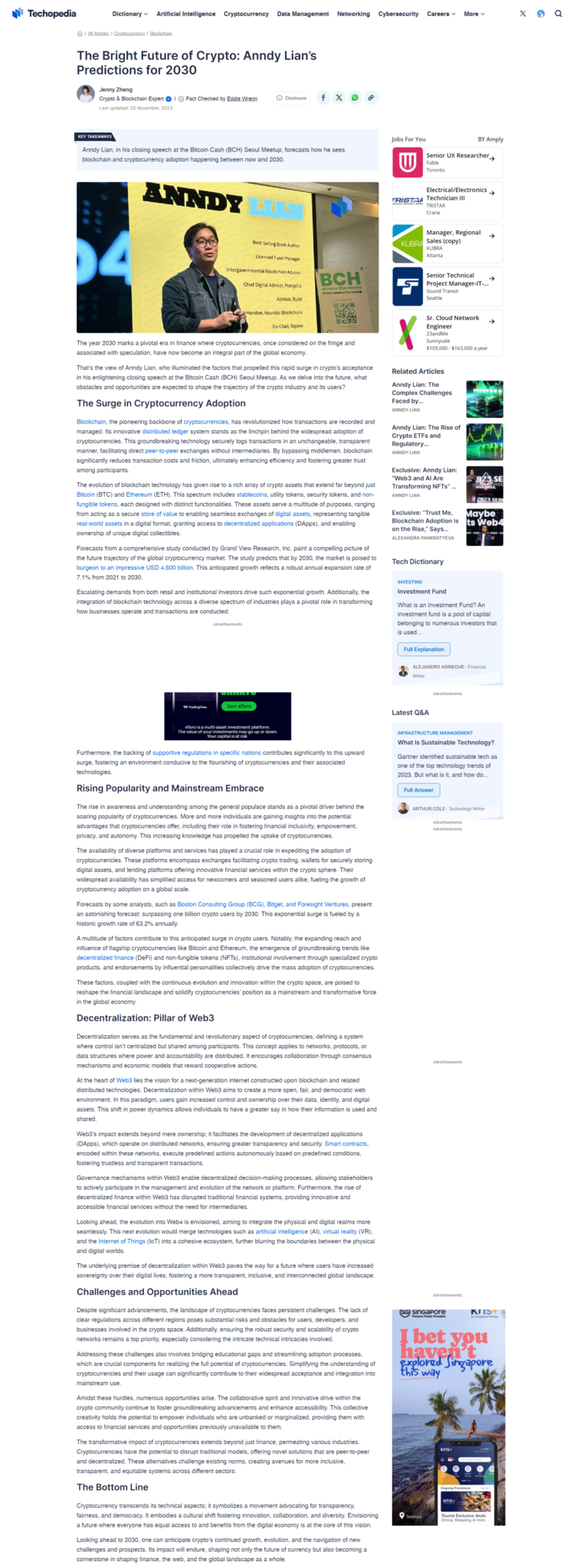
Anndy Lian is an early blockchain adopter and experienced serial entrepreneur who is known for his work in the government sector. He is a best selling book author- “NFT: From Zero to Hero” and “Blockchain Revolution 2030”.

Currently, he is appointed as the Chief Digital Advisor at Mongolia Productivity Organization, championing national digitization. Prior to his current appointments, he was the Chairman of BigONE Exchange, a global top 30 ranked crypto spot exchange and was also the Advisory Board Member for Hyundai DAC, the blockchain arm of South Korea’s largest car manufacturer Hyundai Motor Group. Lian played a pivotal role as the Blockchain Advisor for Asian Productivity Organisation (APO), an intergovernmental organization committed to improving productivity in the Asia-Pacific region.

An avid supporter of incubating start-ups, Anndy has also been a private investor for the past eight years. With a growth investment mindset, Anndy strategically demonstrates this in the companies he chooses to be involved with. He believes that what he is doing through blockchain technology currently will revolutionise and redefine traditional businesses. He also believes that the blockchain industry has to be “redecentralised”.


j j j

Closing Speech by Anndy Lian: Looking Ahead 2030

Closing Speech by Anndy Lian: Looking Ahead 2030

Fast forward to the year 2030, and we find ourselves in a world dramatically altered over the past decade, especially in finance. What was once a niche and speculative asset class, cryptocurrencies have now transitioned into the mainstream, embraced by millions across the globe. What factors have propelled this astonishing growth and widespread adoption of crypto, and what challenges and opportunities lie ahead for the crypto industry and its users?

The Swift Expansion of Cryptocurrencies

At the core of the crypto revolution is the innovation and evolution of blockchain technology. Blockchain, a distributed ledger system, records transactions in a secure, transparent, and immutable manner. It facilitates peer-to-peer transactions without intermediaries, reducing costs, minimizing friction, and enhancing efficiency and trust.

Blockchain’s transformative power has paved the way for the emergence of various crypto assets, including Bitcoin, Ethereum, stablecoins, utility tokens, security tokens, non-fungible tokens (NFTs), and more. These digital assets serve diverse purposes, ranging from acting as a store of value and medium of exchange to representing real-world assets digitally, offering access to decentralized applications (DApps), and enabling the ownership of digital collectibles.

A study by Grand View Research, Inc. forecasts the global cryptocurrency market to reach USD 11.71 billion by 2030, expanding at a compound annual growth rate (CAGR) of 7.1% from 2021 to 2030. This growth is attributed to the surging demand for crypto assets among both retail and institutional investors, the increasing integration of blockchain technology in various sectors, and the favorable regulatory climate in some countries.

Rising Popularity and Mainstream Acceptance

Another driving force behind crypto adoption is the growing awareness and education among the general public. More individuals are becoming acquainted with the benefits and potential of cryptocurrencies, such as financial inclusion, empowerment, privacy, and sovereignty. The availability and accessibility of various platforms and services, including exchanges, wallets, payment processors, lending platforms, and more, further facilitate this adoption.

A report on Github estimates that the number of crypto users will surpass one billion by 2030, based on a historical growth rate of 63.2% per year. The report identifies key drivers of crypto adoption, including the expansion of Bitcoin and Ethereum, the advent of DeFi and NFTs, the introduction of institutional products and services, and endorsements from celebrities and influencers.

Challenges and Opportunities

Despite the remarkable progress and potential of crypto, several challenges and uncertainties demand attention:

– Regulation and Compliance
– Security and Scalability
– Education and Adoption

On the flip side, numerous opportunities await exploration within the crypto space:

– Innovation and Development
– Inclusion and Empowerment
– Transformation and Disruption

Conclusion

Crypto transcends being merely a technology, currency, or asset—it represents a movement, a culture, and a vision. It is a movement that strives to build a more open, fair, and democratic world. It is a culture that values innovation, collaboration, and diversity. It is a vision that foresees a future where everyone can participate, contribute, and reap the benefits of the digital economy.

Looking ahead to 2030, we can anticipate the continued growth, evolution, and maturation of crypto, with new challenges and opportunities on the horizon. Crypto’s impact extends beyond being the future of money; it encompasses the future of the web and, indeed, the future of the world.

The BCH Meet up was held in South Korea on 28 October 2023. The closing speech is made by Anndy Lian. He is an all-rounded business strategist in Asia. He has provided advisory across a variety of industries for local, international, public listed companies and governments.

The full write-up will be found at https://anndy.com.

Anndy Lian is an early blockchain adopter and experienced serial entrepreneur who is known for his work in the government sector. He is a best selling book author- “NFT: From Zero to Hero” and “Blockchain Revolution 2030”.

Currently, he is appointed as the Chief Digital Advisor at Mongolia Productivity Organization, championing national digitization. Prior to his current appointments, he was the Chairman of BigONE Exchange, a global top 30 ranked crypto spot exchange and was also the Advisory Board Member for Hyundai DAC, the blockchain arm of South Korea’s largest car manufacturer Hyundai Motor Group. Lian played a pivotal role as the Blockchain Advisor for Asian Productivity Organisation (APO), an intergovernmental organization committed to improving productivity in the Asia-Pacific region.

An avid supporter of incubating start-ups, Anndy has also been a private investor for the past eight years. With a growth investment mindset, Anndy strategically demonstrates this in the companies he chooses to be involved with. He believes that what he is doing through blockchain technology currently will revolutionise and redefine traditional businesses. He also believes that the blockchain industry has to be “redecentralised”.

j j j

Anndy Lian: Bitcoin Price Surges to $35,000, More Gains Ahead

Anndy Lian: Bitcoin Price Surges to $35,000, More Gains Ahead

Bitcoin, the world’s largest and most popular cryptocurrency, has been on a bullish streak lately, reaching $35,000 for the first time since May 2022. The digital asset has more than doubled in value this year as investors flock to it amid inflation fears, regulatory developments, and growing adoption.

One of the main drivers of Bitcoin’s rally is the anticipation of a spot Bitcoin exchange-traded fund (ETF) approval by the U.S. Securities and Exchange Commission (SEC). A spot ETF would allow investors to buy and sell Bitcoin directly on regulated stock exchanges without having to deal with crypto platforms or custody issues.

Several companies have applied for a spot in Bitcoin ETF, including BlackRock (NYSE:BLK), WisdomTree, Invesco Galaxy, Wise Origin, VanEck, Bitwise, and Valkyrie Digital Assets. The SEC has postponed its decision on these applications until November, but some analysts believe that the regulator will eventually greenlight at least one of them.

A spot Bitcoin ETF would be a game-changer for the crypto industry, as it would boost the liquidity, accessibility, and legitimacy of Bitcoin. It would also attract more institutional and retail investors to the market, creating more demand and driving up the price.

Another factor that is fueling Bitcoin’s rise is the upcoming halving event in 2024. The halving is a process that reduces the reward for mining new blocks of Bitcoin by 50% every four years. This creates a scarcity effect that increases the value of each coin. The halving also coincides with a cyclical pattern of Bitcoin’s price movements, which tend to peak about a year after each halving.

The last halving occurred in May 2020, when the reward dropped from 12.5 to 6.25 bitcoins per block. Since then, Bitcoin has surged from around $9,000 to over $35,000. The next halving is expected to happen in May 2024, when the reward will drop to 3.125 bitcoins per block. Many experts believe that this will trigger another bull run that could push Bitcoin to new heights.

One of them is Peter Brandt, a legendary trader and analyst who has been following Bitcoin since 2011. Brandt has recently shared his bullish chart that predicts new all-time highs for Bitcoin by the third quarter of 2024. He says that Bitcoin has hit its bottom at around $25,000 in July 2023 and will break out of its long-term range by mid-2024. He also suggests that Bitcoin will go through a period of consolidation or sideways movement until then.

Brandt’s chart shows that Bitcoin follows a series of bullish impulses followed by periods of correction. He expects that Bitcoin will reach around $40,000 in the short term, based on its convincing break above the $32,000 level. He then forecasts that Bitcoin will correct to around $30,000 before resuming its uptrend and reaching new highs above $70,000 by Q3 2024.

Brandt is not alone in his optimistic outlook. Other analysts have also made bold predictions for Bitcoin’s future price. Some of them include:

  • Alistair Milne, founder of Altana Digital Currency Fund, predicts that Bitcoin will surge to $45,000 depending on what happens with inflation.
  • Dan Tapiero, co-founder of 10T Holdings and Gold Bullion International, who believes that Bitcoin could reach $100,000 by 2025.
  • Tim Draper, billionaire investor and founder of Draper Associates and DFJ Venture Capital, expects that Bitcoin will hit $250,000 by mid-2023.
  • John McAfee, a software entrepreneur and crypto advocate, who claims that Bitcoin will reach $1 million by 2025.

Why I Think Bitcoin Will Drop to $29,000 Before Surging to $40,000

Bitcoin, the world’s leading cryptocurrency, has been on a roller coaster ride this year, reaching new highs and lows. As of writing this article, Bitcoin is trading at around $35,000, up from its recent low of $25,000 in July 2023. However, I believe that this rally is not sustainable and that Bitcoin will face another major correction before it can break out of its long-term range and reach new heights.

There are several reasons why I think Bitcoin will drop to $29,000 before it can surge to $40,000 and above. These include:

  • The lack of a spot Bitcoin ETF approval by the SEC
  • The increasing competition from other cryptocurrencies and technologies
  • The diminishing returns of the halving effect

Let me explain each of these points in detail.

The lack of a spot Bitcoin ETF approval by the SEC

One of the main catalysts for Bitcoin’s recent rally is the expectation of a spot Bitcoin ETF approval by the U.S. Securities and Exchange Commission (SEC). A spot ETF would allow investors to buy and sell Bitcoin directly on regulated stock exchanges without having to deal with crypto platforms or custody issues.

However, I think that this expectation is too optimistic and that the SEC will not approve any spot Bitcoin ETF anytime soon. The SEC has been very cautious and sceptical about Bitcoin and crypto in general, citing issues such as market manipulation, fraud, volatility, liquidity, custody, and investor protection.

The SEC has already postponed its decision on several spot Bitcoin ETF applications until November, but I doubt that it will grant any approval by then. The SEC has rejected or delayed every Bitcoin ETF proposal since 2013, and I don’t see any reason why it would change its stance now.

Therefore, I think that the market is overestimating the probability of a spot Bitcoin ETF approval and that this will lead to disappointment and sell-off when the SEC announces its verdict. I expect that this will trigger a downward pressure on Bitcoin’s price and push it below $30,000.

The increasing competition from other cryptocurrencies and technologies

Another factor that could weigh on Bitcoin’s price is the increasing competition from other cryptocurrencies and technologies that offer faster, cheaper, more scalable, and more innovative solutions.

Bitcoin is the first and most dominant cryptocurrency, but it is not the only one. There are thousands of other cryptocurrencies that have emerged since Bitcoin’s inception in 2009, each with its own features, advantages, and disadvantages.

Some of these cryptocurrencies are challenging Bitcoin’s supremacy in different aspects, such as:

  • Ethereum, which is the second-largest cryptocurrency by market cap and the leading platform for smart contracts, decentralized applications (DApps), decentralized finance (DeFi), non-fungible tokens (NFTs), and more.
  • Cardano, which is the third-largest cryptocurrency by market cap and a rival to Ethereum that claims to offer a more scalable, secure, and sustainable platform for smart contracts and DApps.
  • Solana, which is the fifth-largest cryptocurrency by market cap and a high-performance blockchain that boasts over 50,000 transactions per second (TPS), low fees, and interoperability with other blockchains.
  • Dogecoin, which is the ninth-largest cryptocurrency by market cap and a meme-inspired coin that has gained popularity among retail investors and celebrities such as Elon Musk.

These are just some examples of the many alternatives to Bitcoin that are gaining traction and adoption in the crypto space. These cryptocurrencies are not only competing for market share but also for innovation and development.

While Bitcoin has a loyal fan base and a strong network effect, it also suffers from some limitations and challenges that could hinder its growth potential. Some of these include:

  • Its slow transaction speed of around 7 TPS, makes it unsuitable for micropayments or high-frequency transactions
  • Its high transaction fees of around $10 per transaction, which make it expensive for small or frequent transfers
  • Its limited scalability is due to its fixed block size of 1 MB, which limits its capacity to handle more transactions per second
  • Its high energy consumption is due to its proof-of-work (PoW) consensus mechanism, which requires a lot of computing power and electricity to secure the network
  • Its lack of programmability due to its simple scripting language, which limits its ability to support complex functions or applications

These limitations could make Bitcoin less attractive or relevant compared to other cryptocurrencies or technologies that offer better solutions or features. Therefore, I think that Bitcoin will face more competition and pressure from other players in the crypto space and that this will affect its price negatively.

The diminishing returns of the halving effect

A third reason why I think Bitcoin will drop to $29,000 before it can surge to $40,000 is the diminishing returns of the halving effect.

The halving is a process that reduces the reward for mining new blocks of Bitcoin by 50% every four years. This creates a scarcity effect that increases the value of each coin. The halving also coincides with a cyclical pattern of Bitcoin’s price movements, which tend to peak about a year after each halving.

The last halving occurred in May 2020, when the reward dropped from 12.5 to 6.25 bitcoins per block. Since then, Bitcoin has surged from around $9,000 to over $35,000. The next halving is expected to happen in May 2024, when the reward will drop to 3.125 bitcoins per block.

Many experts believe that this will trigger another bull run that could push Bitcoin to new heights. However, I think that this effect will be weaker and less predictable than before.

There are several reasons why I think the halving effect will diminish over time. These include:

  • The decreasing impact of the reward reduction on the supply and demand of Bitcoin. As the reward gets smaller and smaller, it will have less influence on the inflation rate and the market price of Bitcoin. For instance, the first halving in 2012 reduced the inflation rate from 50% to 25%, while the fourth halving in 2024 will reduce it from 1.8% to 0.9%. This means that the supply shock will be less significant and less noticeable than before.
  • The increasing difficulty and cost of mining Bitcoin. As the reward gets smaller and smaller, it will become harder and more expensive for miners to break even or make a profit. This could lead to some miners exiting or reducing their operations, which could affect the security and stability of the network. It could also create more selling pressure on the market, as miners need to sell some of their coins to cover their expenses.
  • The decreasing correlation between the halving and the price cycles of Bitcoin. As Bitcoin matures and becomes more influenced by other factors such as adoption, regulation, innovation, and competition, it will become less dependent on the halving as a price driver. The halving may not be as reliable or accurate as a predictor or indicator of future price movements as before.

Therefore, I think that the halving effect will not be as strong or consistent as before and that it will not be enough to propel Bitcoin to new highs without other positive catalysts or developments.

Conclusion

Of course, these predictions are not guaranteed to come true and should be taken with a grain of salt. Bitcoin is a volatile and unpredictable asset that can be influenced by many factors beyond anyone’s control. Some of the risks and challenges that could affect Bitcoin’s price include:

  • Regulatory uncertainty and crackdowns from governments and central banks
  • Cyberattacks and hacks on crypto platforms and users
  • Technical issues and bugs in the Bitcoin network or software
  • Competition from other cryptocurrencies and technologies
  • Market manipulation and fraud by whales and bad actors
  • Loss of confidence and trust among investors and users

Therefore, anyone who is interested in investing in Bitcoin should do their own research and due diligence before making any decisions. They should also be aware of the potential rewards and risks involved and be prepared for high volatility and price swings.

Bitcoin is a revolutionary and innovative invention that has changed the world of finance and technology. It has also created a new asset class that offers unprecedented opportunities and challenges for investors and users. As Bitcoin enters its second decade of existence, it will continue to evolve and grow, and possibly reach new heights that no one can imagine.


Source: https://in.investing.com/analysis/anndy-lian-bitcoin-price-surges-to-35000-more-gains-ahead-200601620


Anndy Lian is an early blockchain adopter and experienced serial entrepreneur who is known for his work in the government sector. He is a best selling book author- “NFT: From Zero to Hero” and “Blockchain Revolution 2030”.

Currently, he is appointed as the Chief Digital Advisor at Mongolia Productivity Organization, championing national digitization. Prior to his current appointments, he was the Chairman of BigONE Exchange, a global top 30 ranked crypto spot exchange and was also the Advisory Board Member for Hyundai DAC, the blockchain arm of South Korea’s largest car manufacturer Hyundai Motor Group. Lian played a pivotal role as the Blockchain Advisor for Asian Productivity Organisation (APO), an intergovernmental organization committed to improving productivity in the Asia-Pacific region.

An avid supporter of incubating start-ups, Anndy has also been a private investor for the past eight years. With a growth investment mindset, Anndy strategically demonstrates this in the companies he chooses to be involved with. He believes that what he is doing through blockchain technology currently will revolutionise and redefine traditional businesses. He also believes that the blockchain industry has to be “redecentralised”.

j j j