Seoul’s Calculated Embrace: Why South Korea’s Crypto Pivot Is a Blueprint—and a Warning

Seoul’s Calculated Embrace: Why South Korea’s Crypto Pivot Is a Blueprint—and a Warning

South Korea has arrived at a decisive turning point in the global digital asset story, one that reflects both the ambitions and anxieties shaping the next phase of crypto’s evolution. For nearly a decade, the country functioned as a peculiar enclave—a retail-dominated “walled garden” defined by feverish speculation, the notorious “Kimchi Premium,” and a regulatory posture that lurched unpredictably between permissiveness and crackdown. That chapter is now closing.

The January decision to lift a nine-year ban on corporate crypto trading, paired with the increasingly assertive enforcement of the Virtual Asset User Protection Act, marks not just a policy shift but a state-directed transformation. South Korea is no longer merely participating in the crypto market; it is attempting to redesign it.

The reopening to institutional players is, at first glance, a watershed moment. By allowing publicly listed companies and professional investors to allocate up to 5 percent of their equity capital annually into digital assets—albeit confined to the top 20 cryptocurrencies by market capitalization and traded on five regulated exchanges—Seoul is channeling substantial capital into the ecosystem. Roughly 3,500 corporations now stand poised to re-enter the market, bringing with them the promise of deeper liquidity and a moderating influence on the retail-driven volatility that has long defined Korean exchanges. If successful, the policy could also erode the persistent arbitrage gaps that have historically separated Korea’s crypto prices from global benchmarks.

From a market-structure standpoint, the approach is undeniably cautious, even conservative. By restricting corporate exposure to established assets such as Bitcoin and Ethereum, regulators aim to shield balance sheets from the turbulence of speculative altcoins. Yet embedded within this prudence is a deeper philosophical tension. The same framework that promotes stability also risks starving smaller, experimental projects of institutional capital. Innovation in the crypto space has often emerged from the margins, from precisely the kinds of ventures now excluded from meaningful funding channels. South Korea has made a clear choice: stability over experimentation, order over dynamism. The consequences of that choice will reverberate well beyond its borders.

Nowhere is the state’s preference for control more evident than in enforcement. The Virtual Asset User Protection Act, in effect since July 2024, has moved decisively from theory to practice. Early 2026 brought the first criminal prosecutions under its provisions, including a February ruling that imposed a three-year prison sentence for a wash-trading scheme that generated roughly 7.1 billion won—about $54.6 million—in illicit gains. Exchanges are now required to maintain continuous, round-the-clock surveillance for “abnormal transactions,” with immediate reporting obligations for suspicious activity. What was once a loosely policed marketplace has become a tightly monitored financial system.

Additional safeguards reinforce this transformation. Service providers must now store at least 80 percent of user assets in offline cold wallets, backed by insurance or reserve funds—a measure that directly addresses the industry’s long history of devastating hacks. Combined with a late-2025 Supreme Court ruling that cryptocurrencies held on exchanges constitute “property” subject to seizure, and the imminent rollout of cross-border reporting requirements, the architecture of oversight is becoming comprehensive. These changes undoubtedly strengthen consumer protection. But they also signal something broader: a level of state visibility that would have been unthinkable in crypto’s earlier, more anarchic phase.

The tightening net becomes even more apparent in the planned expansion of the Travel Rule. By lowering the reporting threshold to encompass nearly all transactions and requiring monthly disclosures of cross-border transfers to the Bank of Korea, regulators are effectively eliminating transactional anonymity. Authorities justify these measures by pointing to the outsized role of arbitrage—particularly the Kimchi Premium—in foreign exchange violations, which they claim account for more than 80 percent of such crimes. The rationale is compelling. Yet the implications are profound. A system designed to eradicate illicit activity risks, in the process, erasing the privacy that once defined the ethos of blockchain technology. The pursuit of transparency, taken to its logical extreme, begins to resemble a surveillance regime.

Against this backdrop, the repeated delay of a 20 percent capital gains tax—now scheduled for January 2027—introduces a curious note of ambiguity. Officials cite unresolved “infrastructure gaps,” including the difficulty of tracking decentralized transactions and defining taxable events such as staking rewards or airdrops. In practical terms, the postponement creates a temporary equilibrium: a market enjoying increasing legitimacy without the immediate burden of taxation. This “Goldilocks” period may prove beneficial in the short term, allowing institutions to acclimate and compliance systems to mature. But it also perpetuates uncertainty, complicating long-term planning for both investors and firms.

The government’s alignment with the OECD’s Crypto-Asset Reporting Framework, expected to be adopted by dozens of countries in 2027, suggests that South Korea is not acting in isolation but as part of a broader international convergence. Whether such frameworks can adequately account for the complexities of decentralized finance remains an open question. The risk, as always, is that intricate technological ecosystems are forced into regulatory templates designed for far more conventional financial instruments. Nuance tends to disappear in translation.

Looking ahead, the proposed Digital Asset Basic Act—expected by late 2026—aims to fill remaining gaps in the regulatory landscape. Its provisions for stablecoins, likely requiring full reserve backing held in banks, reflect a direct response to the trauma of the Terra-Luna collapse. Meanwhile, a separate framework for Security Token Offerings, scheduled for early 2027, seeks to integrate tokenized real-world assets into the existing capital markets regime. These initiatives promise clarity, but they also underscore the complexity of the undertaking. Even well-intentioned measures can produce unintended consequences.

A proposed 34 percent ownership cap for major shareholders in crypto exchanges, designed to prevent monopolistic control, may inadvertently deter the very institutional investment the broader policy framework seeks to attract. At the same time, the staggered rollout of reforms risks creating a prolonged period of regulatory limbo, particularly for emerging sectors that depend on clear rules to innovate.

South Korea’s experiment offers a strikingly dual-edged lesson. On one side lie the benefits: stronger consumer protections, reduced systemic risk, a more stable market structure, and the legitimizing influence of institutional capital. On the other side are the trade-offs, which are no less significant. Rising compliance costs could consolidate the exchange ecosystem into a narrow oligopoly, diminishing competition and limiting consumer choice. The erosion of privacy raises fundamental questions about the balance between security and autonomy. And the deliberate privileging of established assets may entrench incumbents while sidelining the very innovations that have historically driven the sector forward.

What South Korea is attempting is not simply regulation. It is market design. The goal is a crypto ecosystem that is liquid, secure, transparent—and firmly bounded by state oversight. Such a system may well deliver the stability and credibility needed to attract traditional finance. But it also redefines the boundaries of what crypto is meant to be. The world is watching closely, not just to see whether prices stabilize or institutions pile in, but to understand whether a system engineered for control can still nurture the openness and experimentation that gave rise to the technology in the first place.

The blueprint is taking shape in Seoul. The question now is whether it leaves enough room for the future it seeks to govern.


Source: https://intpolicydigest.org/seoul-s-calculated-embrace-why-south-korea-s-crypto-pivot-is-a-blueprint-and-a-warning/

Anndy Lian is an early blockchain adopter and experienced serial entrepreneur who is known for his work in the government sector. He is a best selling book author- “NFT: From Zero to Hero” and “Blockchain Revolution 2030”.

Currently, he is appointed as the Chief Digital Advisor at Mongolia Productivity Organization, championing national digitization. Prior to his current appointments, he was the Chairman of BigONE Exchange, a global top 30 ranked crypto spot exchange and was also the Advisory Board Member for Hyundai DAC, the blockchain arm of South Korea’s largest car manufacturer Hyundai Motor Group. Lian played a pivotal role as the Blockchain Advisor for Asian Productivity Organisation (APO), an intergovernmental organization committed to improving productivity in the Asia-Pacific region.

An avid supporter of incubating start-ups, Anndy has also been a private investor for the past eight years. With a growth investment mindset, Anndy strategically demonstrates this in the companies he chooses to be involved with. He believes that what he is doing through blockchain technology currently will revolutionise and redefine traditional businesses. He also believes that the blockchain industry has to be “redecentralised”.

j j j

Korea NFT Projects Should Embrace Community To Build Success, Says BigONE Exchange’s Anndy Lian

Korea NFT Projects Should Embrace Community To Build Success, Says BigONE Exchange’s Anndy Lian

Speaking at the 1st Korea Blockchain Conference (KBCC) on February 15, 2022, the Chairman of BigONE Exchange Anndy Lian underlined the importance of a powerful online community to securing the success of any NFT project.


As well as the obvious boom in NFT artwork, and in Korea the use of NFTs to promote K-pop, Lian said the growth in the use of NFTs to connect fans and artists through all-access type membership was notable: “Whether it’s to get closer to your favorite UFC fighter or singer these are hot trends in the market right now driven by the power of community.”


Another form of community where we are going to see the growth of NFTs is around meme coins, he added: “That kind of utility is really powerful because they have the community backing them you know, so they will have the benefit of starting their NFT project with a few hundred thousand users right at the start.” It was for this reason, due to the strength of their community, that Lian added that he saw these big communities as personally worth investing in.


In terms of Korea’s leading role in blockchain innovation Lian told the panel audience that from his experience, talking with corporations such as Samsung and Hyundai, as well as senior Government officials, the key players are all very mindful of the importance of blockchain technology for the country’s future. “It’s not simply about creating decentralized data storage but how this technology will be embedded in our lives, enabling the automation of all aspects of the economy for the benefit of all citizens.”

The panel titled ‘Blockchain Technology, Innovation And Opportunity’ was led by Jenny Zheng (Bybit, NFT BD Lead), Anndy Lian (BigONE Exchange, Chairman), Davy Goh (Passion VC, CEO), and Joe Lu (Origin Storage, Partner), and Hwang Byung-sun (Big Bang Angels, CEO).

The event’s opening session was given by HS88 Chairman Kim Ho-seong. The session ended with a speech by Won Hee-ryong, a member of the People’s Power, and Lee Sang-ki, the Korean representative of the World Blockchain Organization (WBO).

KBCC was designed to help the growth and development of the blockchain industry. The event aims to let the South Korean audiences know more about the technology by bringing foreign experts to share their experience.

About BigONE Exchange


BigONE is a global cryptocurrency exchange that provides a platform for trading various cryptocurrencies. It was founded in 2017 and registered in the Netherlands. The group operates in Russia, Brazil, Vietnam, Seychelles, Singapore, Japan, and Indonesia, providing marketing, investment, and blockchain technology research & development. Further information here.


Contact:

Name: Linda

Email: linda@big.one

Website: www.big.one


Original Source: https://www.marketwatch.com/press-release/korea-nft-projects-should-embrace-community-to-build-success-says-bigone-exchanges-anndy-lian-2022-03-07

Anndy Lian is an early blockchain adopter and experienced serial entrepreneur who is known for his work in the government sector. He is a best selling book author- “NFT: From Zero to Hero” and “Blockchain Revolution 2030”.

Currently, he is appointed as the Chief Digital Advisor at Mongolia Productivity Organization, championing national digitization. Prior to his current appointments, he was the Chairman of BigONE Exchange, a global top 30 ranked crypto spot exchange and was also the Advisory Board Member for Hyundai DAC, the blockchain arm of South Korea’s largest car manufacturer Hyundai Motor Group. Lian played a pivotal role as the Blockchain Advisor for Asian Productivity Organisation (APO), an intergovernmental organization committed to improving productivity in the Asia-Pacific region.

An avid supporter of incubating start-ups, Anndy has also been a private investor for the past eight years. With a growth investment mindset, Anndy strategically demonstrates this in the companies he chooses to be involved with. He believes that what he is doing through blockchain technology currently will revolutionise and redefine traditional businesses. He also believes that the blockchain industry has to be “redecentralised”.

j j j

The Edge Markets: Singapore’s wary crypto embrace leaves top mogul in the cold

The Edge Markets: Singapore’s wary crypto embrace leaves top mogul in the cold

(Jan 12): Binance Holdings Ltd Chief Executive Officer Changpeng Zhao was putting on a brave face.

An affiliate of the world’s largest cryptocurrency exchange had just withdrawn its application to run a bourse in Singapore. Zhao, the richest person in cryptocurrency with a fortune of about US$90 billion, took to Twitter to say the affiliate’s investment in another exchange — one that was regulated — made the application “somewhat redundant.”

As it turns out, the other exchange has a licence to trade some things — such as shares in private companies and tokenized assets — but not cryptocurrencies. More importantly, the real reason for the withdrawal was that Binance’s affiliate didn’t meet Singapore’s criteria for protecting against money laundering and terrorist financing, a person familiar with the matter said after it happened last month. Binance denies this, saying it pulled the application on strategic and commercial grounds.

“There is a very clear line drawn in the sand,” said Lena Ng, a partner at Clifford Chance who advises cryptocurrency players in Singapore and internationally.

The cryptocurrency industry is attracting the attention of regulators around the world, with US Securities and Exchange Commission Chair Gary Gensler labelling it the “Wild West” and saying it needs more oversight. The Singapore example shows the regulatory process won’t always be easy for the companies involved, even as states express openness to the concepts and technologies.

Ravi Menon, the managing director of the Monetary Authority of Singapore, the central bank and financial regulator, laid out Singapore’s approach in an interview with Bloomberg in October. The city-state sees promise in areas such as decentralisation, smart contracts and encryption, and wants to be well-positioned if they become integral to our economies, he said. But there are also “serious risks,” he said, giving the examples of money laundering and terrorist financing.

“It could lead to nowhere, or it could lead to a lot of risk and turmoil, or it could lead to a very good outcome for the economy and the society,” Menon said of the crypto phenomenon. “We have to look at it in terms of scenarios, and prepare ourselves for any of those outcomes.”

Singapore’s Payment Services Act came into effect in January 2020, providing a framework for regulating areas from trading Bitcoin to using tokens for payments. Under the law, MAS hands out so called digital payment token licences to crypto companies that make it through the application process.

The act’s introduction helped accelerate an inflow of crypto players into the Southeast Asian city.

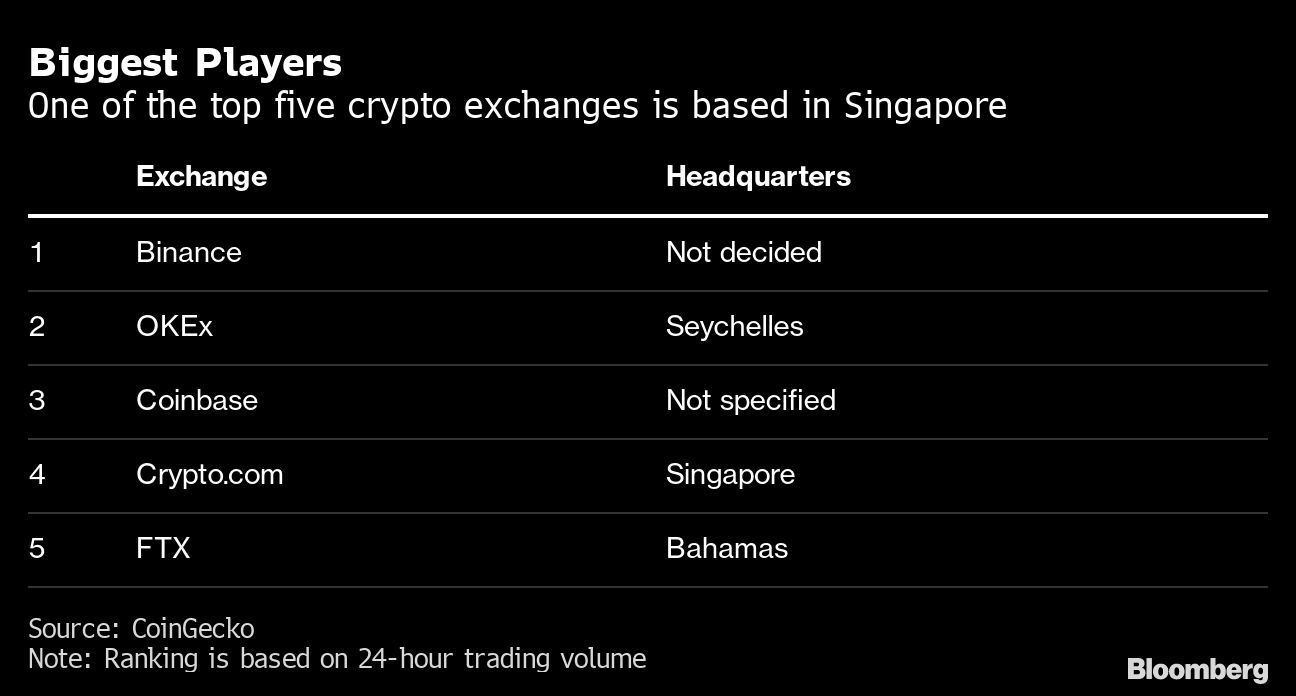
Crypto.com, the world’s fourth-largest cryptocurrency bourse, relocated its headquarters from Hong Kong in 2021 and is seeking a licence. An affiliate of Huobi Group, which operated China’s biggest crypto exchange before last year’s blanket ban, is also applying, and its co-founder Du Jun has spent the last two years in Singapore. Binance’s Zhao, for that matter, had also been based in the city-state for the past two years.

All told, some 170 firms applied, including Coinbase Global Inc, the exchange that went public in the US last year in a landmark moment for the crypto industry. Gemini Trust, the bourse founded by Tyler and Cameron Winklevoss, is also among the applicants. Companies that have put in an application are allowed to operate in the city under a grace period until the regulator says otherwise or they drop out.

But about 100 applicants have already withdrawn or been rejected. Most failed to meet Singapore’s criteria for preventing illicit flows of funds, a person familiar with the matter has said.

In fact, only four are known to have received their licences, including Independent Reserve, an Australian cryptocurrency exchange, and the brokerage unit of DBS Group Holdings Ltd, Singapore’s largest bank. One other company, local startup Coinhako, said it had received in-principle approval.

“We don’t need 160 of them to set up shop here,” Menon said in the October interview. “Half of them can do so, but with very high standards.”

Singapore is taking a middle ground between the extremes of China, which banned all crypto transactions in September and vowed to stop illegal crypto mining, and El Salvador, which adopted Bitcoin as legal tender that same month.

It’s an approach that has similarities with other Asian financial centres.

Hong Kong, Singapore’s main rival as the region’s leading financial hub, uses a so-called “opt-in” regulatory regime for crypto exchanges, meaning they can apply to be regulated. It has approved one firm. The authorities are in the process of passing laws to enable a new licensing regime.

Japan had recognized 15 companies as cryptocurrency exchange operators as early as 2017, making it one of the pioneers of crypto regulation. As of December, it had given licences to 30 such firms.

South Korea had accepted registrations by 24 crypto-trading exchanges to operate in the country as of Dec 23. Only four of them are allowed to provide trading services in Korean won.

Singapore has advantages for becoming a crypto hub in its low-tax regime and lack of a levy on capital gains, according to Ulisse Dellorto, the Asia-Pacific head of blockchain analytics firm Chainalysis. The city-state also has an edge in ease of doing business, robust infrastructure and connectivity, and the fact that it’s already a financial center, said Gerald Goh, co-founder and Singapore CEO of Sygnum, which runs a digital-asset bank in Switzerland and an asset manager in the Asian city.

Some 350 firms focusing on blockchain and cryptocurrency already operate on the island, according to Chia Hock Lai, co-chairman of the Blockchain Association Singapore, which promotes blockchain technology. That translates into about 3,500 jobs, based on a median staff size of 10, he said.

But the case of Binance, which generated at least US$20 billion of revenue last year according to a Bloomberg analysis, suggests expanding at all costs isn’t necessarily the priority.

There were already signs the writing was on the wall for Zhao’s firm in September, when Singapore’s regulator added Binance.com, the group’s main platform, to its Investor Alert List of unregulated entities that may have been wrongly perceived as licensed or regulated by MAS. It told Binance Holdings to stop offering services regulated in the city-state, allowing only the Singapore entity to serve local residents.

Then in December, almost two years after it applied, Binance withdrew from the process.

“This certainly won’t damage Singapore’s reputation as a crypto hub,” said Neal Cross, a financial-technology entrepreneur and former chief innovation officer of the bank DBS. “In fairness, it may enhance it. Crypto is still nascent and has a long way to go before it becomes a major player in our wealth portfolios, but to make that happen, it needs to happen in a place that is firm but fair.”

A spokesperson for Binance said it’s continuing to work closely with partners and government agencies in Singapore to support the growth of blockchain and cryptocurrency initiatives in the country.

Cross said openness to crypto will yield benefits because blockchain and decentralised finance are likely to make up a large part of the financial services industry in the future. Asked about potential downsides, he said there are two.

“One is the failure of such exchanges” and “the losses incurred by mom and pop investors as these aren’t government-guaranteed”, he said. “Secondly, crypto is notoriously hard to track and hence can open up new pathways to money laundering, but I feel MAS are on top of this with their current regulation.”

MAS’s Menon has repeatedly said Singapore doesn’t want its people speculating on Bitcoin and other volatile cryptocurrencies.

“MAS frowns on cryptocurrencies or tokens as an investment asset for retail investors,” he said in a December speech. Cryptocurrency prices “are not anchored on any economic fundamentals and are subject to sharp speculative swings. Investors in these tokens are at risk of suffering significant losses.”

Bitcoin, the largest cryptocurrency, more than doubled from the start of 2021 through a high in November before tumbling for the rest of the year. In 2018, it plunged 74%. The digital token slid less than 0.1% on Wednesday to trade at US$42,649.75.

People chasing digital investment opportunities should exercise caution and participate “responsibly”, Minister for Communications and Information Josephine Teo said Jan 11.

Singapore’s desire to protect its public from crypto trading has echoes in its policy for its two casinos, which have been a big economic success but came with concerns its people would be affected by gambling. In response, the government charges a S$150 (US$111) daily entry fee for citizens and permanent residents, while foreigners get in for free.

To be sure, not everyone is positive about Singapore’s crypto strategy.

“When Binance left, it became a statement that Singapore doesn’t welcome the big boys,” said Anndy Lian, the chairman of cryptocurrency bourse BigONE Exchange. “Many people are going for Dubai, because they see Singapore as not welcoming, and don’t know the real reasons behind that.”

Binance itself has turned to the Middle East, signing a cooperation agreement with the Dubai World Trade Centre Authority last month on the emirate’s planned virtual asset ecosystem. It also got in-principle approval from Bahrain’s central bank to be a crypto-asset service provider in the kingdom. And it appointed Richard Teng, a high-profile hire who joined Binance’s Singapore affiliate as its CEO in August, as the global entity’s head of the Middle East and North Africa.

Meanwhile, back in Singapore, a billboard for Crypto.com shouted its message in bold at a busy crossing on the Orchard Road shopping belt. “Fortune favours the brave,” it declared.

That may be true, or it may also favour the cautious. For Huobi Singapore CEO Edward Chen, the key is to get the mix just right.

“It is important to find the right balance between regulation and mitigating risks while still maintaining a competitive edge,” Chen said.


Original Source: https://www.theedgemarkets.com/article/singapores-wary-crypto-embrace-leaves-top-mogul-cold

Anndy Lian is an early blockchain adopter and experienced serial entrepreneur who is known for his work in the government sector. He is a best selling book author- “NFT: From Zero to Hero” and “Blockchain Revolution 2030”.

Currently, he is appointed as the Chief Digital Advisor at Mongolia Productivity Organization, championing national digitization. Prior to his current appointments, he was the Chairman of BigONE Exchange, a global top 30 ranked crypto spot exchange and was also the Advisory Board Member for Hyundai DAC, the blockchain arm of South Korea’s largest car manufacturer Hyundai Motor Group. Lian played a pivotal role as the Blockchain Advisor for Asian Productivity Organisation (APO), an intergovernmental organization committed to improving productivity in the Asia-Pacific region.

An avid supporter of incubating start-ups, Anndy has also been a private investor for the past eight years. With a growth investment mindset, Anndy strategically demonstrates this in the companies he chooses to be involved with. He believes that what he is doing through blockchain technology currently will revolutionise and redefine traditional businesses. He also believes that the blockchain industry has to be “redecentralised”.
j j j