Blockchain for Business: Top Use Cases, Benefits & Pitfalls in 2024

Blockchain for Business: Top Use Cases, Benefits & Pitfalls in 2024

blockchain is a shared and immutable data storage technology that is used for payments, supply chain management, trade operations, tokenization, and privacy solutions.

The technology is finding its way into the corporate world because of its unique properties that allow the creation of programmable, transparent, accessible, secure, and trustless systems.

Anndy Lian, an intergovernmental blockchain experttold Techopedia:

“It is not just financial systems; blockchain can empower individuals to take control of their personal data and privacy, mitigating risks associated with centralized data storage. We’re at the early stages of understanding how blockchain and crypto can revolutionize various industries. From supply chain management to healthcare, the potential applications are vast.”

What are the benefits of blockchain applications? What are the challenges that companies may face when adopting blockchain tech? We explore these and highlight some of the most popular use cases of blockchain for businesses in various sectors.

Key Takeaways

  • Blockchain tech has unique properties that allow the creation of programmable, transparent, accessible, secure, and trustless systems.
  • Blockchains are used for payroll, supply chain management, trade operations, tokenization, privacy, and retail operations.
  • Businesses can use public blockchains like Ethereum or create their custom private blockchains.
  • Businesses can use blockchain to build trust, improve privacy, reduce costs, facilitate cross-border payments, and more.
  • Uncertainty around crypto regulation is a key hindrance in adopting blockchain technology.

What Are the Major Blockchain Applications Across Industries?

Here are some of the most popular blockchain use cases and examples of using blockchain for small businesses and large corporations.
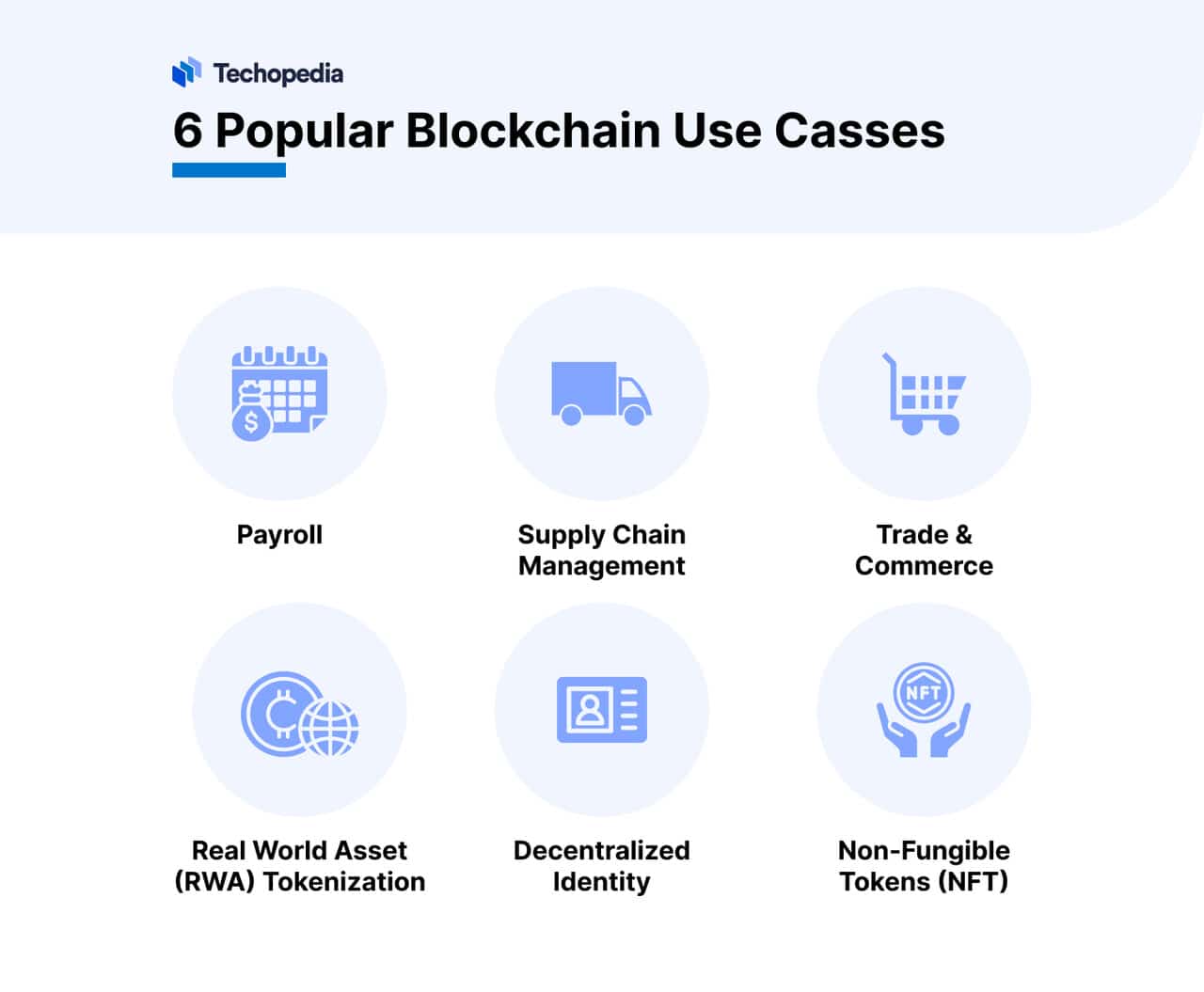
Six Popular Blockchain Use Cases

Payroll

Payments are an obvious use case of blockchain technology. The cryptocurrency industry has used blockchain technology as a bedrock to build peer-to-peer payment systems, while governments are leveraging blockchain technology to create central bank digital currencies (CBDCs).

The growth of remote work has also helped this trend grow as crypto payments facilitate easy, quick, and cheap cross-border payments.

For example, the human resources (HR) management platform Deel allows companies to pay and contractors to receive their salaries in BTCETHUSDC, Dash (DASH), Solana (SOL), and BUSD.

Supply Chain Management

Blockchain supply chain management solutions modernize complex chains that have numerous intermediary parties, processes and endpoints.

The transparent and immutable nature of a blockchain ledger ensures that all concerned parties have a single trusted source of information while providing information in real time to all concerned parties.

Blockchain supply chain solutions also reduce paper-based processes and email exchanges and allow automation, thereby increasing transaction speeds.

Trade management company Covantis created a network to process the execution of bulk agricultural trade operations from the appointment of third-party providers to sharing of documentary instructions and generating drafts and final documents.

Trade & Commerce

Blockchain solutions for trade and commerce created a reliable platform to help buyers find sellers, negotiate with each other, and complete the trade without having to meet each other.

These trading platforms store agreed-upon contracts on the blockchain, while smart contracts custody funds and automate payments when real-world conditions are met. All the information remains visible to all parties on the blockchain.

IBM created a blockchain-based trade management platform we.trade that solves the issue of lack of trust. Importers and exporters that don’t know each other can securely connect with each other on we.trade.

Real World Asset (RWA) Tokenization

Tokenization of real world assets is a promising blockchain use case for businesses that want to increase market liquidity for illiquid assets like real estate. Tokenization can also be used to safeguard intellectual property like copyrights and patents by storing them on an immutable blockchain network.

RWA tokenization is among the top five crypto market trends and technologies in 2024. Traditional finance companies are tokenizing illiquid real estate and fine art into thousands of digital tokens, bringing down the entry barrier for small investors. At the same time, the global nature of public blockchains like Ethereum (ETH) has allowed RWA tokens to reach investors from across the world.

Lian said:

“I believe that tokenization has the potential to democratize access to investment opportunities, allowing individuals from diverse backgrounds to participate in previously inaccessible markets.”

The world saw the first tokenization of real estate in June 2019 when a luxury property called ​​AnnA Villa in France was divided into thousands of digital tokens on the Ethereum blockchain with a minimum entry ticket of investment of €6.5. The tokens came with ownership rights, voting rights, and a one-year vesting period for initial token holders.

Decentralized Identity

Data privacy and security are key issues that businesses have to deal with every day. Using blockchain technology, corporations can leverage a privacy-preserving identity management system called decentralized identity.

Decentralized identities are stored on the blockchain and are not controlled, managed, and stored by centralized third parties. The use of zero-knowledge proof technology, which is gaining popularity on public blockchains, allows organizations to create identifications and certificates that can be verified without revealing any information. Decentralized identification prevents certificate fraud, fake credentials, slow verification processes, and data leaks.

Health-focused enterprise enablement company BurstIQ provides a blockchain-powered platform called LifeGraph that manages sensitive health data. Healthcare and life sciences companies can secure customer data to a single source where participants can control others’ access to their data. Permissioned data can be analyzed, without violating data privacy norms, for improved efficiency, better decision-making, and increased effectiveness in medical processes.

Non-Fungible Tokens (NFT)

Although crypto NFTs are typically associated with absurd market prices, their broad use cases are often misunderstood. Consumer brands like Nike, Puma, and Louis Vuitton have used NFTs as a marketing tool and as a way to digitize and enhance shopping experience.

Since acquiring digital art studio RTFKT in 2021, Nike has occasionally released exclusive NFTs that can be redeemed for physicals. Similarly, in 2023, French luxury fashion house Louis Vuitton sold “phygital” NFTs called Treasure Trunks – worth €39,000 a piece, as reported by Vogue – that granted owners access to goods and experiences.

In September 2022, Starbucks piloted a customer rewards program powered by NFTs called Starbucks Odyssey. However, the company later shut the program in March 2024.

Benefits & Pitfalls of Blockchain for Business

Benefits

  • Trust
  • Improved Privacy & Security
  • Reduced Costs
  • Faster Settlements
  • Programmability & Customizability
  • Tokenization

Challenges

  • Technical Expertise & Investment
  • Regulation Uncertainty
  • Risk of Hacks
  • Limited User Adoption
  • Energy Consumption
  • Scalability & Interoperability

Benefits of Blockchain for Business

Here are the key benefits of using blockchain tech for business operations:

1. Building Trust

Blockchains when paired with smart contract technology can create trustless systems that are immutable, transparent and objective in nature. In a world where there is growing distrust over corporate practices, the use of blockchain technology can help generate trust.

2. Improved Privacy & Security

Although blockchains are not immune to hacks, the development of cryptographic technologies such as zk-proof can ensure data privacy and safety. ZK-proof technology is especially useful in protecting private data as it allows data verification without revealing any information.

Businesses can also leverage public blockchains such as Ethereum to store data and transact upon. The decentralized nature of public blockchains ensures that no centralized party has the power to modify or delete stored data.

3. Reduced Costs


Blockchain technology can help organizations reduce costs by making supply chain and trade management systems efficient, transparent, and accountable. This is especially useful for corporations that have to conduct business operations on the assumption of trust.

4. Faster Settlements

The use of blockchain technology shines when it comes to payments. Cryptocurrency blockchains are global in nature and operate 24/7 making them perfect channels for cheap and immediate cross-border payments.

Unlike the traditional banking sector, businesses will not have to wait for banking hours for settlement and will not incur multiple fees applicable in international money routing.

5. Programmability & Customizability

Businesses have the choice to use different types of blockchains depending on their needs. For example, public crypto blockchains are suitable for handling payrolls, while private blockchains can be developed to allow access to only concerned parties within a supply chain or trade operation.

Furthermore, the use of programmable smart contracts allows the development of applications that use the underlying blockchain networks for data storage and transaction settlement. Smart contracts also allow automation where transactions self-execute when specific conditions are met.

6. Tokenization

Tokenization fits financial use cases. The borderless nature of public blockchains like Ethereum and Solana allows tokenized financial assets to attract a wider pool of investors from across the globe.

Potential Challenges & Pitfalls

Here are the biggest barriers to blockchain adoption in business:

1. Requirement of Technical Expertise & Investment

Businesses will incur costs when recruiting blockchain experts and implementing blockchain technology. The use of public blockchains will require businesses to pay gas fees and auditing fees when setting up applications and smart contracts. Meanwhile, the development of private blockchains from scratch may be expensive and time-consuming due to its complexity.

2. Regulation

The uncertainty around cryptocurrency regulations is one of the biggest challenges in implementing blockchain technology for businesses. Cryptocurrency and blockchain applications often face difficulty finding banking partners in regions with unfriendly and unclear crypto regulations.

The uncertain crypto rules and regulations can hamper business progress and discourage customers from using blockchain-based applications.

3. Hacks

Blockchains are not immune to hacks. 51% attacksdouble-spending, and sybil attacks are key risks to public blockchains. Furthermore, businesses must conduct thorough audits of their smart contracts before deployment or risk being compromised.

4. Limited User Adoption

Blockchain technology is relatively nascent, and therefore, businesses may encounter resistance from trade partners, supply chain management parties and consumers when they introduce blockchain-based solutions. Low awareness about blockchain and cryptocurrency technology among concerned parties is a major hurdle in this area.

5. High Energy Consumption of Proof-of-Work Blockchains

Proof-of-work (PoW) blockchains like Bitcoin are criticized for their high energy consumption rates and carbon footprint. Businesses looking to use these blockchains may attract criticism from customers and investors.

6. Scalability

Public blockchains like Bitcoin and Ethereum often face scalability issues that have resulted in limited network throughput. High transaction volumes on these networks can result in transaction execution failure, exorbitant transaction fees, and delayed transaction processing.

7. Interoperability

Blockchains are often referred to as “data silos” as they tend to exist in isolation from other blockchain networks.

The lack of interoperability between blockchains leads to inefficiencies as businesses will have to rely on third-party solutions to retrieve data from a foreign blockchain.

Fragmentation of data can also hinder collaboration and stifle innovation between businesses or departments within a corporation.

The Bottom Line

Blockchain is a revolutionary technology that offers unique value propositions like trustlessness, transparency, immutability and decentralization.

When duly implemented, blockchain can help corporations make their business operations more efficient and bring about a social and cultural change where trustless and transparent systems become the norm.


Source: https://www.techopedia.com/blockchain-for-business-your-enterprise-guide

Anndy Lian is an early blockchain adopter and experienced serial entrepreneur who is known for his work in the government sector. He is a best selling book author- “NFT: From Zero to Hero” and “Blockchain Revolution 2030”.

Currently, he is appointed as the Chief Digital Advisor at Mongolia Productivity Organization, championing national digitization. Prior to his current appointments, he was the Chairman of BigONE Exchange, a global top 30 ranked crypto spot exchange and was also the Advisory Board Member for Hyundai DAC, the blockchain arm of South Korea’s largest car manufacturer Hyundai Motor Group. Lian played a pivotal role as the Blockchain Advisor for Asian Productivity Organisation (APO), an intergovernmental organization committed to improving productivity in the Asia-Pacific region.

An avid supporter of incubating start-ups, Anndy has also been a private investor for the past eight years. With a growth investment mindset, Anndy strategically demonstrates this in the companies he chooses to be involved with. He believes that what he is doing through blockchain technology currently will revolutionise and redefine traditional businesses. He also believes that the blockchain industry has to be “redecentralised”.

j j j

I use strategies such as diversification to manage risks: Blockchain expert Anndy Lian

I use strategies such as diversification to manage risks: Blockchain expert Anndy Lian

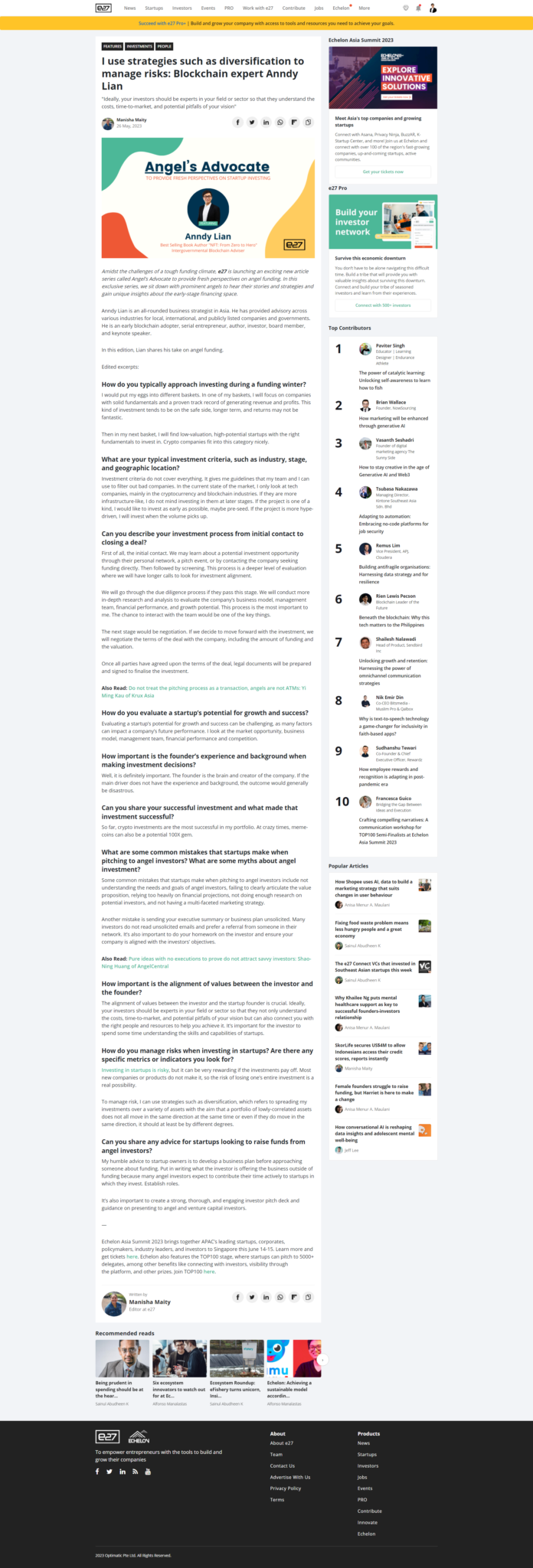
Amidst the challenges of a tough funding climate, e27 is launching an exciting new article series called Angel’s Advocate to provide fresh perspectives on angel funding. In this exclusive series, we sit down with prominent angels to hear their stories and strategies and gain unique insights about the early-stage financing space.

Anndy Lian is an all-rounded business strategist in Asia. He has provided advisory across various industries for local, international, and publicly listed companies and governments. He is an early blockchain adopter, serial entrepreneur, author, investor, board member, and keynote speaker.

In this edition, Lian shares his take on angel funding.

Edited excerpts:

How do you typically approach investing during a funding winter?

I would put my eggs into different baskets. In one of my baskets, I will focus on companies with solid fundamentals and a proven track record of generating revenue and profits. This kind of investment tends to be on the safe side, longer term, and returns may not be fantastic.

Then in my next basket, I will find low-valuation, high-potential startups with the right fundamentals to invest in. Crypto companies fit into this category nicely.

What are your typical investment criteria, such as industry, stage, and geographic location?

Investment criteria do not cover everything. It gives me guidelines that my team and I can use to filter out bad companies. In the current state of the market, I only look at tech companies, mainly in the cryptocurrency and blockchain industries. If they are more infrastructure-like, I do not mind investing in them at later stages. If the project is one of a kind, I would like to invest as early as possible, maybe pre-seed. If the project is more hype-driven, I will invest when the volume picks up.

Can you describe your investment process from initial contact to closing a deal?

First of all, the initial contact. We may learn about a potential investment opportunity through their personal network, a pitch event, or by contacting the company seeking funding directly. Then followed by screening. This process is a deeper level of evaluation where we will have longer calls to look for investment alignment.

We will go through the due diligence process if they pass this stage. We will conduct more in-depth research and analysis to evaluate the company’s business model, management team, financial performance, and growth potential. This process is the most important to me. The chance to interact with the team would be one of the key things.

The next stage would be negotiation. If we decide to move forward with the investment, we will negotiate the terms of the deal with the company, including the amount of funding and the valuation.

Once all parties have agreed upon the terms of the deal, legal documents will be prepared and signed to finalise the investment.

How do you evaluate a startup’s potential for growth and success?

Evaluating a startup’s potential for growth and success can be challenging, as many factors can impact a company’s future performance. I look at the market opportunity, business model, management team, financial performance and competition.

How important is the founder’s experience and background when making investment decisions?

Well, it is definitely important. The founder is the brain and creator of the company. If the main driver does not have the experience and background, the outcome would generally be disastrous.

Can you share your successful investment and what made that investment successful?

So far, crypto investments are the most successful in my portfolio. At crazy times, meme-coins can also be a potential 100X gem.

What are some common mistakes that startups make when pitching to angel investors? What are some myths about angel investment?

Some common mistakes that startups make when pitching to angel investors include not understanding the needs and goals of angel investors, failing to clearly articulate the value proposition, relying too heavily on financial projections, not doing enough research on potential investors, and not having a multi-faceted marketing strategy.

Another mistake is sending your executive summary or business plan unsolicited. Many investors do not read unsolicited emails and prefer a referral from someone in their network. It’s also important to do your homework on the investor and ensure your company is aligned with the investors’ objectives.

How important is the alignment of values between the investor and the founder?

The alignment of values between the investor and the startup founder is crucial. Ideally, your investors should be experts in your field or sector so that they not only understand the costs, time-to-market, and potential pitfalls of your vision but can also connect you with the right people and resources to help you achieve it. It’s important for the investor to spend some time understanding the skills and capabilities of startups.

How do you manage risks when investing in startups? Are there any specific metrics or indicators you look for?

Investing in startups is risky, but it can be very rewarding if the investments pay off. Most new companies or products do not make it, so the risk of losing one’s entire investment is a real possibility.

To manage risk, I can use strategies such as diversification, which refers to spreading my investments over a variety of assets with the aim that a portfolio of lowly-correlated assets does not all move in the same direction at the same time or even if they do move in the same direction, it should at least be by different degrees.

Can you share any advice for startups looking to raise funds from angel investors?

My humble advice to startup owners is to develop a business plan before approaching someone about funding. Put in writing what the investor is offering the business outside of funding because many angel investors expect to contribute their time actively to startups in which they invest. Establish roles.

It’s also important to create a strong, thorough, and engaging investor pitch deck and guidance on presenting to angel and venture capital investors.


Source: https://e27.co/i-use-strategies-such-as-diversification-to-manage-risks-blockchain-expert-invest-anndy-lian-20230524/

Anndy Lian is an early blockchain adopter and experienced serial entrepreneur who is known for his work in the government sector. He is a best selling book author- “NFT: From Zero to Hero” and “Blockchain Revolution 2030”.

Currently, he is appointed as the Chief Digital Advisor at Mongolia Productivity Organization, championing national digitization. Prior to his current appointments, he was the Chairman of BigONE Exchange, a global top 30 ranked crypto spot exchange and was also the Advisory Board Member for Hyundai DAC, the blockchain arm of South Korea’s largest car manufacturer Hyundai Motor Group. Lian played a pivotal role as the Blockchain Advisor for Asian Productivity Organisation (APO), an intergovernmental organization committed to improving productivity in the Asia-Pacific region.

An avid supporter of incubating start-ups, Anndy has also been a private investor for the past eight years. With a growth investment mindset, Anndy strategically demonstrates this in the companies he chooses to be involved with. He believes that what he is doing through blockchain technology currently will revolutionise and redefine traditional businesses. He also believes that the blockchain industry has to be “redecentralised”.

j j j

India: Use Tax Compliant Platform To Comply With Budget

India: Use Tax Compliant Platform To Comply With Budget

Union Budget 2023 had to offer very little for virtual digital assets (VDA) sector. In fact, the Finance Minister carefully avoided even mentioning about the VDA. However, the industry players took it in stride by acknowledging the fact that they need to abide by the current dispensation. They have advised using tax compliant platform while are hopeful of rise in Web3 & Crypto adoption.

The recent budget has brought gains from overseas cryptocurrencies / VDA under the tax purview. Non abidance of which invites Rs 10 lakh penalty or seven year imprisonment.

“I think the adoption of Web3 and crypto has grown a lot in India. But pertaining to this with the VDA industry, stakeholders are kind of disappointed by the Finance minister not mentioning the sector in her Union budget speech on 1st of February,” said Anndy Lian, Author & advisor for the Mongolian Productivity Organization.

While providing a perspective from across the border and being a staunch advocate of cryptocurrency, Lian believes that the budget 2023 has established its priority towards tax collection.

“I would just want to say that don’t try to avoid TDS by using offshore. You may be penalized as per section 271C of the income tax Act if you are investing in a Crypto,” Lian warned adding that, “Try to use a tax compliant platform, again the words used are fairly ambiguous”.

Similar views were aired by other experts tracking VDA sector.

According to a recent analysis, India’s cumulative trade volume in VDA changed by INR 32,000 crore between February and October 2022. “We expected that in the 2023 budget, the government would t alter VDA taxation, thereby reducing tax burden and eliminating uncertainties. But sadly we are still holding last years baby!,” says Raj Kapoor, founder, India Blockchain Alliance.

He went on to add that VDA taxes impact both residents and non-residents. Without a clear set of criteria to identify when NRs in India become subject to taxation, it has now become critical to understand the status of VDAs, especially when they are exchanged via or sold to Indian citizens. Clear standards in this sector are required to clear the air and promote international investment.

Joining the bandwagon in support of VDA traders is Tax Expert, Sonu Jain, who says “Many Indian users were purchasing crypto assets using International Credit cards or funds transfer. This will now reduce significantly since the TCS has been increased to 20%.”

Concerned by the tax imposition, Jain said, “So every funds transfer under LRS will be leviable to 20% TCS. For example, If a user wishes to buy crypto worth ₹100, then ₹20 will have to be paid as TCS.” This will significantly reduce direct International crypto purchases by Indians..

India assumed the presidency of the G20 summit, and there are hopes with regards to the country moving towards a more favorable ecosystem for crypto in general. Most importantly, India has started 450 web3 startups with an average inflow of 1.3 billion dollars in 2022 according to DYDX foundation. According to media reports there are over 75,000 blockchain employees working in India, raking 3rd in the global list of employers.


Source: https://www.3-verse.io/3versetv/blog/use-tax-compliant-platform-to-comply-with-budget/BA-20230203181601187-721508

Anndy Lian is an early blockchain adopter and experienced serial entrepreneur who is known for his work in the government sector. He is a best selling book author- “NFT: From Zero to Hero” and “Blockchain Revolution 2030”.

Currently, he is appointed as the Chief Digital Advisor at Mongolia Productivity Organization, championing national digitization. Prior to his current appointments, he was the Chairman of BigONE Exchange, a global top 30 ranked crypto spot exchange and was also the Advisory Board Member for Hyundai DAC, the blockchain arm of South Korea’s largest car manufacturer Hyundai Motor Group. Lian played a pivotal role as the Blockchain Advisor for Asian Productivity Organisation (APO), an intergovernmental organization committed to improving productivity in the Asia-Pacific region.

An avid supporter of incubating start-ups, Anndy has also been a private investor for the past eight years. With a growth investment mindset, Anndy strategically demonstrates this in the companies he chooses to be involved with. He believes that what he is doing through blockchain technology currently will revolutionise and redefine traditional businesses. He also believes that the blockchain industry has to be “redecentralised”.

j j j