Are we heading for a post-Terra crypto winter?

Are we heading for a post-Terra crypto winter?

Terra’s LUNA and UST implosion is dragging down an already ailing market. What do other developments suggest about crypto’s long-term future?

The Terra crash has doubled down on people’s fears that the sharp downturn in the crypto market, much like the steep rise in U.S. inflation, isn’t transitory but could be longer-lasting.

Led by Bitcoin’s fall from grace, down from its spectacular US$69,000 high in November 2021 down to US$33,000 in January this year, crypto commentators were already noting the first signs of a “crypto winter.” But the final nails in the coffin now include record-busting inflation rates in the U.S., a Federal Reserve getting serious by raising interest rates, and the risk of recession after the tapering off the trillions of dollars injected into the economy.

And it’s not just Bitcoin with its seventh red candle week in a row. Ethereum is also currently down around 58% from its all-time high, and altcoins are down around 80% in value. It’s not a pretty picture, made even worse by the US$40 billion flash crash of LUNA and TerraUSD, which had, “a domino effect on the rest of the cryptocurrency market, tanking the price of Bitcoin and accelerating the loss of $300 billion in value across the crypto economy.” To cap it off, total value locked (TVL) in decentralized finance (DeFi) dropped last week to US$56 billion, according to industry monitor DeFi Pulse, and even NFTs dropped 65% after the Terra fiasco. Overall crypto markets lost a total of US$1 trillion in April.

But if this is the start of another market cycle, dramatized by Terra, there is plenty that marks it as different from previous downturns, not least that the regulatory attention on the crypto industry that was already in motion will be accelerated. “Standing between broad-based mainstream adoption of crypto infrastructure for commerce and financial applications at a global scale is this regulatory clarity,” Circle CEO Jeremy Allaire told Yahoo Money. “We have the impetus to see that happen now.”

Just as importantly, countries around the world aren’t suddenly going to row back on their engagement with the crypto and blockchain space. Indeed, news that South Korean regulators are investigating Terra may in the longer run help to strengthen plans for crypto-friendly legislation promised by the incoming new president.

Another sign that long-term crypto adoption is moving forward is confirmed by the British government, which says it is planning to regulate crypto, including allowing stablecoins to be a form of payment, as part of its bid to turn the nation into a global crypto hub. It’s therefore excellent timing for Coinbase to launch a global crypto think tank to help mold policy debate about the industry.

Another key player, venture capital firm Andreessen Horowitz (a16z), in its first State of Crypto Report stated that we are now in the middle of the fourth “price innovation” cycle. Which in plain English means that despite the current market downturn, the hard work in the background with development will lead to innovation and growth in the longer term and the start of a new cycle. “Whereas prices are often a lagging indicator of performance in some industries, in crypto they are a leading indicator,” wrote the authors of the a16z report. “Prices are a hook. The numbers drive interest, which drives ideas and activity, which in turn drives innovation.”

While the euphoric tone of the Bitcoin 2022 conference in Miami in early April may seem a distant memory right now, the news from Jack Mallers, CEO of Strike, advancing their Lightning Network-based solution is significant. The integration of the Strike wallet with major online players in the U.S. economy aligns with Satoshi’s vision of Bitcoin as a payment system rather than a store of value. It’s also worth noting the Lighting Network-related news from ex-Diem head David Marcus, in the midst of the Terra events on May 12, to launch a new company, Lightspark: “Downturns are good moments to focus on building and creating value with mission-aligned people.” Despite FTX CEO Sam Bankman-Fried’s criticism of Bitcoin for payments, this has scope to offer an exciting integration with fiat money that could be the major development to come out of the current downturn.

In the meantime, while we can only guess at the depth of the crypto downturn, it’s clear that the same basic tenets of investing remain — that retail investors in particular should only get involved with a clear plan in mind. They should only invest what they can afford to lose and be careful with the inherent volatility of crypto assets, and not invest too much as part of their overall portfolio. Part of what made the Terra crash so shocking was that it drew in crypto newcomers who were confident, in part thanks to the high level of prominent venture capitalists investing in the startup and its stablecoin product. But sometimes, as we learned with the 2008 financial market crash, what appears to be the safest assets on the surface can prove to be the riskiest.

However, it’s the long-term investments in the crypto industry that will make the real difference. With recent news that banking pillars like Goldman Sachs are investing in the space, to Meta’s plans to process digital asset payments and investments, a clear difference between the last downturn and this one is the level of institutional and governmental adoption.


Original Source: https://finance.yahoo.com/news/heading-post-terra-crypto-winter-030200028.html


j j j

Wrapped LUNA price prediction: Can WLUNA resurface?

Wrapped LUNA price prediction: Can WLUNA resurface?

The crypto market has been battling one of its biggest selloffs, which saw the TerraUSD (UST) stablecoin and its sister cryptocurrency, LUNA, lose over 90% of value within days.

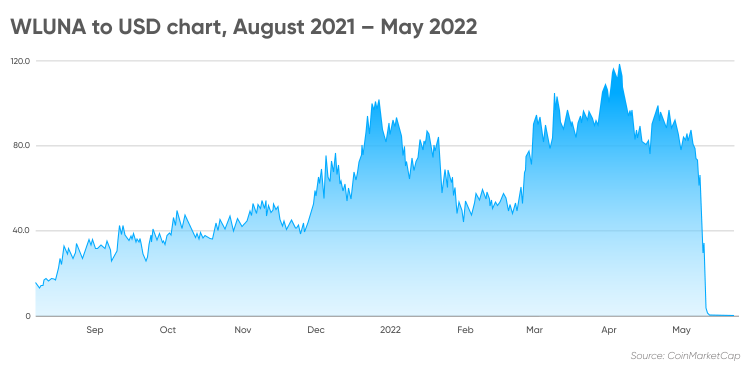
The LUNA-pegged token wrapped LUNA (WLUNA), was also affected by this blow to the cryptomarket as its value depends on the performance of LUNA. Between 5 May 2022 and 23 May 2022, the value of WLUNA fell from $86.03 to $0.000209.2.

Terra’s co-founder, Do Kwon, launched a plan to fork the Terra blockchain on 18 May 2022 in an attempt to get  the token back to its previous values. However, so far, the plan seems to have had no effect on the WLUNA token price. Will the token resurface and what’s next for the WLUNA crypto price prediction?

What is the wrapped LUNA token?

wrapped token is a cryptocurrency pegged to the value of another cryptocurrency built to represent it on a separate blockchain. Wrapped coins can be redeemed for the cryptocurrency that they represent at any given moment and their function and operation is very similar to that of stablecoins. However, instead of being pegged to fiat currency, their value mimics that of another digital asset.

Wrapped coins increase interoperability between blockchains that are usually designed in a way that makes it impossible to pass information between them.

Launched in August 2021, the wrapped LUNA (WLUNA) cryptocurrency is the compatible version of the LUNA coin built on the Ethereum (ETH) network.

The LUNA token is the native cryptocurrency of the Terra ecosystem. LUNA is a staking protocol token. TerraUSD (UST) is a stablecoin pegged to the US dollar. UST tokens are minted each time LUNA tokens are burned.

If the value of UST goes above $1, then the same amount of LUNA tokens would be burned, minting more UST and making the stablecoin less valuable. However, if the UST is valued below $1, they can be swapped for LUNA, making the tokens more valuable.

WLUNA tracks the value of the original LUNA token on ERC-20 standards, which means it can be minted on the Ethereum blockchain and has utility with other decentralised finance (DeFi) protocols built on Ethereum. One LUNA can be exchanged for one WLUNA and vice-versa.

Other uses of the WLUNA cryptocurrency include:

  • Tokenisation –  an increased speed of transactions; reduced number of intermediaries; enhanced security; greater usability; and improved transparency.
  • Liquidity on decentralised exchanges and decentralised applications (dApps).
  • Interoperability between cryptocurrencies.
  • On chain ways to enhance policies (rules on asset transfer or trade).

The circulating supply of WLUNA coins stood at over six trillion as of the time of writing (23 May), according to data provided by CoinMarketCap. The cryptocurrency had a market capitalisation surpassing $1.22bn and was ranked as the 2849th biggest token.

WLUNA was on a joyous ride

The wrapped luna coin price was on an upward trend from the early days of its launch, closely following the 2021 surge of the LUNA token.

WLUNA to USD chart, August 2021 – May 2022

As the price of WLUNA is directly correlated to LUNA, the token’s 2021 success was driven by developments in the TerraLuna ecosystem.

Although WLUNA’s value dropped in January 2022, it reversed and continued rising until the end of February 2022, when a wider crypto market sell-off wiped out nearly 50% of its value down to $52.71 on 24 February 2022.

At the start of March 2022, the WLUNA to USD price started to resurface once again and hit an all-time high of $117.98 on 5 April 2022 following a month’s pace of steady surging as the double rewards for UST launched on Polkadot (DOT) via StellaSwap (STELLA).

However, the token dipped by around 35% in the following weeks to $76.22 by 18 April 2022. Even though the token regained its value and traded at relative highs throughout the remainder of April and the start of May, more recent wrapped luna token news saw its price dip by nearly 98% from $66.19 on 8 May 2022 to $1.4318 on 11 May 2022.

The WLUNA dip

In the second week of May LUNA was still in the top 10 biggest cryptocurrencies. But, ever since UST lost its peg to the US dollar, the token – along with the wrapped LUNA coin – has been in freefall.

Many attributed LUNA’s freefall to broader negative crypto market sentiment, which saw bitcoin (BTC), the biggest cryptocurrency by market capitalisation, trading below the $27,000 value for the first time since June 2020.

However, days after the dip, reports speculated that the cryptocurrency crashed as investors decided to carry out a plan that saw them purchasing a large sum of BTC to buy UST, with the intention of profiting once the value of UST fell. This led the UST to depeg from the US dollar and lose all of its value, dragging LUNA and WLUNA down with it.

Others speculated  that the cryptocurrency lost its value due to its high dependency on the Anchor Protocol, a UST savings account that paid a 20% interest rate and made the asset a very popular investment.

In March 2022, Anchor announced that it was planning to readjust its interest rates after passing a new community vote which would see the rates drop or increase 1.5% each month. Following the news, many investors chose to empty their Anchor wallets and sell their TerraUSD, LUNA and WLUNA tokens.

In a reply to the massive LUNA and UST crash, Do Kwon said on Twitter that he was “close to announcing a recovery plan for $US”, which came days later in the form of a new Terra blockchain vote “to rename the existing network Terra Classic, LUNA Classic (LUNC), and rebirth a new Terra blockchain & LUNA (LUNA).”

Does WLUNA have a bright future?

The new community vote proposed by Kwon would see the Terra blockchain split in two. If the vote passes, the old chain will be called Terra Classic and LUNA renamed Luna Classic ( LUNC).

The plan is for the current chain and new chain to exist simultaneously, but operate separately. The new chain, on the other hand, would ditch the UST stablecoin and would instead use the LUNA cryptocurrency.

Although Kwon Do noted that his proposal had “broad support” from the community tagging a number of accounts, many users were unhappy with this announcement. Despite this fact, as of 23 May, the vote seems to be passing with over 171 million investors voting in its favour.

The Terra platform is also planning to launch Terra 2.0, an updated version of its ecosystem.

BigOne Exchange chair in Asia Anndy Lian told Capital.com that Coinbase (COIN), one of the world’s leading crypto exchanges, will be suspending WLUNA and UST trading on 27 May 2022, which could be a “sign of big volatility to come”.

“In order for a possibility for wrapped LUNA to work, LUNA got to work. Exchanges are still cautious of LUNA, UST and their ecosystem of tokens. Anchor and Mirror for example are also suspended due to the downfall of LUNA. New investors understand the volatility and always do their own research before embarking on this token again,” he added.

Since the UST and LUNA tokens collapsed, many crypto exchanges including Binance, OKX and Crypto.com have also suspended their trading.

Wrapped LUNA token price prediction 2022-2025, 2030

Despite the latest downward price action, algorithm-based forecasting service Wallet Investor gave a bullish WLUNA price prediction at the time of writing (23 May). The site noted that wrapped LUNA is “an awesome long-term investment.”

Based on its analysis of past price performance, Wallet Investor predicted that WLUNA could trade at $76.041 in 2023 and reach $369.024 by 2027.

DigitalCoinPrice supported the positive WLUNA/USD outlook yet saw a much slower pace of growth in the following years, expecting the token to grow to $0.000306 by the end of 2022 and reach $0.000480 by the end of 2025.

By the end of 2028, the site projected that the wrapped LUNA coin forecast could reach $0.000819. Its long-term forecast expected the cryptocurrency to reach $0.00100 by 2030.

Note that predictions about the future of WLUNA can be wrong. Forecasts and analyst expectations shouldn’t be used as a substitute for your own research. Always conduct your own due diligence. Keep in mind that past performance is no guarantee of future returns. And never invest or trade money you cannot afford to lose.


Original Source: https://capital.com/wrapped-luna-wluna-price-prediction

j j j

Are we heading for a post-Terra crypto winter?

Are we heading for a post-Terra crypto winter?

Terra’s LUNA and UST implosion is dragging down an already ailing market. What do other developments suggest about crypto’s long-term future?

The Terra crash has doubled down on people’s fears that the sharp downturn in the crypto market, much like the steep rise in U.S. inflation, isn’t transitory but could be longer-lasting.

Led by Bitcoin’s fall from grace, down from its spectacular US$69,000 high in November 2021 down to US$33,000 in January this year, crypto commentators were already noting the first signs of a “crypto winter.” But the final nails in the coffin now include record-busting inflation rates in the U.S., a Federal Reserve getting serious by raising interest rates, and the risk of recession after the tapering off the trillions of dollars injected into the economy.

And it’s not just Bitcoin with its seventh red candle week in a row. Ethereum is also currently down around 58% from its all-time high, and altcoins are down around 80% in value. It’s not a pretty picture, made even worse by the US$40 billion flash crash of LUNA and TerraUSD, which had, “a domino effect on the rest of the cryptocurrency market, tanking the price of Bitcoin and accelerating the loss of $300 billion in value across the crypto economy.” To cap it off, total value locked (TVL) in decentralized finance (DeFi) dropped last week to US$56 billion, according to industry monitor DeFi Pulse, and even NFTs dropped 65% after the Terra fiasco. Overall crypto markets lost a total of US$1 trillion in April.

But if this is the start of another market cycle, dramatized by Terra, there is plenty that marks it as different from previous downturns, not least that the regulatory attention on the crypto industry that was already in motion will be accelerated. “Standing between broad-based mainstream adoption of crypto infrastructure for commerce and financial applications at a global scale is this regulatory clarity,” Circle CEO Jeremy Allaire told Yahoo Money. “We have the impetus to see that happen now.”

Just as importantly, countries around the world aren’t suddenly going to row back on their engagement with the crypto and blockchain space. Indeed, news that South Korean regulators are investigating Terra may in the longer run help to strengthen plans for crypto-friendly legislation promised by the incoming new president.

Another sign that long-term crypto adoption is moving forward is confirmed by the British government, which says it is planning to regulate crypto, including allowing stablecoins to be a form of payment, as part of its bid to turn the nation into a global crypto hub. It’s therefore excellent timing for Coinbase to launch a global crypto think tank to help mold policy debate about the industry.

Another key player, venture capital firm Andreessen Horowitz (a16z), in its first State of Crypto Report stated that we are now in the middle of the fourth “price innovation” cycle. Which in plain English means that despite the current market downturn, the hard work in the background with development will lead to innovation and growth in the longer term and the start of a new cycle. “Whereas prices are often a lagging indicator of performance in some industries, in crypto they are a leading indicator,” wrote the authors of the a16z report. “Prices are a hook. The numbers drive interest, which drives ideas and activity, which in turn drives innovation.”

While the euphoric tone of the Bitcoin 2022 conference in Miami in early April may seem a distant memory right now, the news from Jack Mallers, CEO of Strike, advancing their Lightning Network-based solution is significant. The integration of the Strike wallet with major online players in the U.S. economy aligns with Satoshi’s vision of Bitcoin as a payment system rather than a store of value. It’s also worth noting the Lighting Network-related news from ex-Diem head David Marcus, in the midst of the Terra events on May 12, to launch a new company, Lightspark: “Downturns are good moments to focus on building and creating value with mission-aligned people.” Despite FTX CEO Sam Bankman-Fried’s criticism of Bitcoin for payments, this has scope to offer an exciting integration with fiat money that could be the major development to come out of the current downturn.

In the meantime, while we can only guess at the depth of the crypto downturn, it’s clear that the same basic tenets of investing remain — that retail investors in particular should only get involved with a clear plan in mind. They should only invest what they can afford to lose and be careful with the inherent volatility of crypto assets, and not invest too much as part of their overall portfolio. Part of what made the Terra crash so shocking was that it drew in crypto newcomers who were confident, in part thanks to the high level of prominent venture capitalists investing in the startup and its stablecoin product. But sometimes, as we learned with the 2008 financial market crash, what appears to be the safest assets on the surface can prove to be the riskiest.

However, it’s the long-term investments in the crypto industry that will make the real difference. With recent news that banking pillars like Goldman Sachs are investing in the space, to Meta’s plans to process digital asset payments and investments, a clear difference between the last downturn and this one is the level of institutional and governmental adoption.

j j j