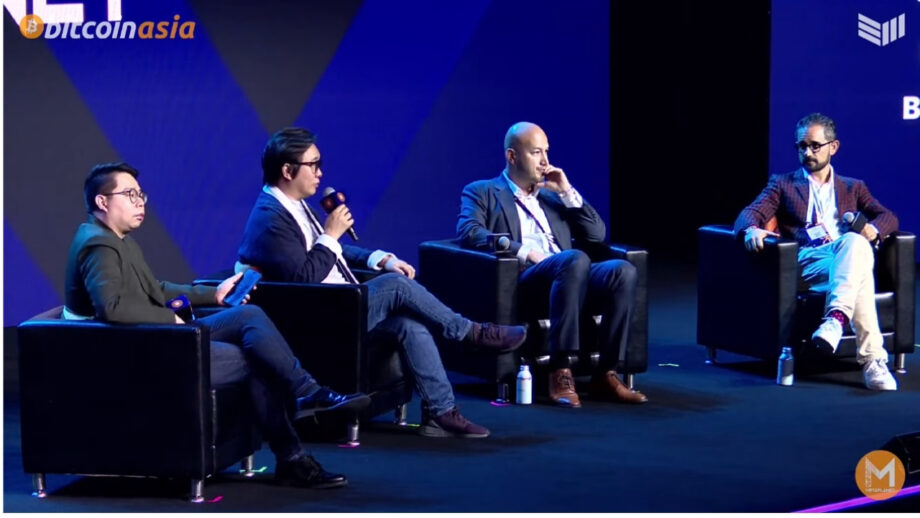
At the Nakamoto Stage of Bitcoin Asia in Hong Kong, a panel of industry leaders gathered to dissect one of the most pressing questions in digital finance: will stablecoin regulation unlock institutional Bitcoin adoption across Asia, or will it inadvertently become a bottleneck?
Moderated by Caspar Wong of Web3Labs, the panel featured Anndy Lian, best-selling author of Web4: The Age of Autonomous Intelligence; Benjamin Quinlan of Quinlan & Associates Limited; and Ben Berenson of Asia SGE. Wong framed the discussion succinctly: “Stablecoins are the bridge between traditional finance and the crypto and Bitcoin ecosystem.” The question, he posed, was whether emerging rules would serve “as a catalyst for institutional Bitcoin adoption or a bottleneck.”
A Fragmented Continent, A Fragmented Strategy
Asia’s regulatory landscape is anything but uniform. Anndy Lian was direct in his assessment: “Most of us would think that Asia operates like a block together, but actually it’s not. Each country is having their own rules.” He contrasted Hong Kong’s institution-driven approach with Singapore’s payment and AML focus, and South Korea’s innovation tempered by capital controls.
Lian echoed a call for harmonisation, suggesting “maybe we should have a more unified set of rules, maybe like a passport that you could use throughout the whole of Asia.” Yet he cautioned regulators against excess: “Have an open mind, have a good set of regulations, but not overreaching on everything. If you start to overreach on each and every aspect for stablecoin, it is very difficult for you to move from country to country.”
Ben Berenson offered a more pragmatic counterpoint. “There’s no pan-Asia unified system. It’s very local,” he said, arguing that the approach must begin at the operational level. “It starts with operations, and when you know how to build an operation in the right way, you gradually kind of fit yourself into the local regulation.” He also raised a pointed governance concern about the passport concept: “If you have a passport and you can get licensed in different jurisdictions based on one authoriser, then who do you blame when things go south?”
Benjamin Quinlan added a layer of nuance, noting that the relevance of stablecoin regulation depends heavily on how institutions access Bitcoin. “If you are an institutional investor and you are investing indirectly through ETFs or other related products, the stablecoin regulations are quite frankly irrelevant,” he said. “If you are looking at a direct access model, then it fundamentally will reflect upon your risk appetite to use non-regulated and/or regulated stablecoin on-off ramps.”
Catalyst or Constraint?
With Hong Kong’s Legislative Council having passed its stablecoin ordinance and two licensed issuers expected to launch in the fourth quarter, the panel examined whether comprehensive regulation would truly open the floodgates.
Lian argued that institutional hesitation stems less from regulation itself than from ambiguity. “The institutions are not worried about regulations, but they are more worried about uncertainties,” he said. “As long as the certainty is there, the regulations are ironclad, everything is there, I think that would not stop any institutions from adopting stablecoin.” He added a warning: “If we slap the traditional finance rules onto all these new stablecoins, that could become a deterrent.”
Quinlan highlighted Hong Kong’s deliberate regulatory design, noting that the two approved issuers were among the city’s three note-issuing banks. He saw this as a trust-building measure: “If a regulator decides they ultimately don’t want those unregulated stablecoins circulating in their jurisdiction, then it will create a natural impetus for these regulated stablecoins to be the correct and regulated and compliant conduit as an on-off ramp into Web3 assets.”
Berenson, meanwhile, cautioned against overlooking less glamorous but equally consequential rules. He pointed to Hong Kong’s new cybersecurity framework, noting that “no one asks how this impacts” crypto players because attention is fixated on the “big buzz around stablecoin.”
Bitcoin at the Centre
True to the conference’s ethos, the panel circled back to Bitcoin itself. Berenson proposed an inversion of the prevailing narrative: “Instead of looking at stablecoin as a settlement for Bitcoin, you can look at Bitcoin as a payment mechanism where the final leg settlement would be with a local issued compliant stablecoin.” He urged institutions to approach banks “in terms of assets rather than focus your strategy around stablecoin with hindrances towards Bitcoin.”
Lian agreed enthusiastically: “If it’s a Bitcoin strategy, I think it’s a bit more sexier than what we see right now. And using Bitcoin as a credit system would be an even more sexier thing.” He called on traditional banks to “come on-chain” and “reap the benefit and the yield on-chain together with us.”
Looking Ahead
In their closing remarks, each panellist painted a picture of the near future. Quinlan envisioned stablecoins becoming “almost indistinguishable” in everyday commerce, where the line between “a stablecoin as a digital asset versus a stablecoin being the equivalent of a digital fiat” dissolves. Lian looked further ahead, referencing his work on autonomous intelligence: “The future is not only about Web2 or Web3… the autonomous intelligence is going to come in and that is also going to create a hell of a lot of money flow.” His rallying cry was simple: “We should go on-chain, man.”
Berenson struck a cautiously optimistic note: “I think payments is a bigger focus right now rather than big banks and big regulations. Those things are in the right direction. So, I’m bullish.”
The consensus from the Nakamoto Stage was clear: stablecoin regulation in Asia will not be a single lightning-bolt moment but a slow, jurisdiction-by-jurisdiction negotiation. The institutions that thrive will be those that treat regulatory clarity not as a constraint, but as the foundation on which to build—and keep Bitcoin firmly at the centre of the strategy.

Anndy Lian is an early blockchain adopter and experienced serial entrepreneur who is known for his work in the government sector. He is a best selling book author. The latest book is Web4: The Age of Autonomous Intelligence.